
Reviewed · THIRD REICH & WWII TOURS
Third Reich Berlin: Hitler and WWII Walking Tour
Berlin is not a place you need to imagine history. You can walk right into it, and this 3-hour route through Nazi command areas and the final battles gives you the story at street level. I especially like seeing Hitler’s bunker area discussed in context, not just pointed at from a sidewalk.
Second, I like how the tour stitches together propaganda and power, with stops tied to Goebbels’ Ministry of Propaganda and the Reichstag’s symbolic turns. It’s the kind of explanation that helps you understand why some places mattered, and why ordinary Berliners suddenly had their lives squeezed by politics and war.
One drawback to plan for: this is a lot of outdoor walking through heavy subject matter, and winter conditions can make that long chilly 3 hours feel longer. Pack warm layers and solid shoes, and give your brain time to process what you see.
Key takeaways before you go
- Street-level Nazi power points without bouncing between far-flung museums
- Reichstag context that links the 1933 fire to the 1945 Soviet flag moment
- Multiple Holocaust-related stops that keep the focus on victims, not just the perpetrators
- Soviet and resistance narratives side-by-side, including names like Klaus von Stauffenberg and Henning von Tresckow
- Guides who answer questions and keep explanations clear, including examples like Maria, RU, Tom, Paul, and Eran
Following the Third Reich’s final chapter, one Berlin block at a time
This tour concentrates on the endgame: Berlin as the last stage of WWII and the Nazi regime’s final grip. You follow a guided path through key sites tied to government control, propaganda, military power, and the Soviet assault that pushed the story toward collapse.
What makes it work for you is the cause and effect. Instead of treating landmarks like isolated postcards, you get a running line about how decisions got made, how propaganda shaped public life, and how resistance tried to interrupt the machine. The tour also brings in resistance leaders by name, including Henning von Tresckow, Hans Oster, and Claus von Stauffenberg, so the story isn’t only about Hitler and his inner circle.
You’ll also see memorials to Nazi opponents and Holocaust victims. That matters because Berlin can tilt toward spectacle if you’re not careful. Here, the walk keeps dragging you back to the human cost.
More Walking Tours in Berlin
- Discover Berlin Half-Day Walking Tour
★ 5.0 · 9,624 reviews - Berlin: Third Reich and Cold War 2 Hour Walking Tour
★ 4.9 · 6,830 reviews - Berlin: Discover Berlin Walking Tour
★ 4.9 · 5,998 reviews
Reichstagufer 17 to Topography of Terror: route flow and pacing
The tour starts at Reichstagufer 17, 10117 Berlin and ends close to Topography of Terror (Niederkirchnerstraße 8, 10963 Berlin), near Checkpoint Charlie. You’re asked to arrive 15 minutes early so the group can gather and head out together.
The duration is about 3 hours, and the group size is capped at 25 travelers. That size keeps the walk from feeling like a moving crowd, but it still means you should expect questions, photo stops, and a steady walking pace.
Practically, plan on a chunk of walking in real city weather. Based on what many people report, expect roughly around 5,000 steps over the route, with stretches that feel brisk. If you’re not into cold-wind endurance, this is where you decide whether to bring gloves, a hat, and an extra layer you can actually move in.
Stop 1: Friedrichstraße Station, where the guide sets the rules of the story
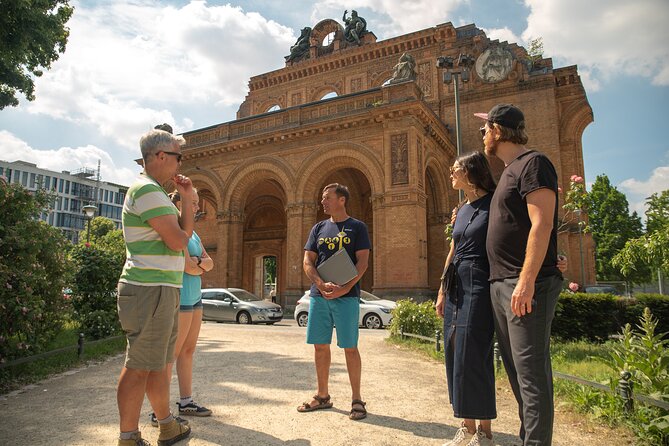
You begin at Berlin Friedrichstraße Station. This first stop acts like a map in human form. Your guide lays out how the sites connect: Nazi government planning zones, the Reichstag area, the Luftwaffe command world, and the final Soviet approach routes.
It’s also where you hear about daily life under air raids and dictatorship, which changes how you read the rest of the walk. Without that setup, the buildings can feel like a list. With it, you start noticing how power sits next to ordinary routines.
One nice touch: the walk immediately mixes different angles. You’re not only hearing about Hitler’s moves. You’re also looking at the infrastructure that enabled oppression and war, including Wilhelmstraße as a key corridor of decision-making.
Wilhelmstraße and the Reichsluftfahrtministerium: Goering’s air power and the machinery of control
A major theme here is administration. Berlin was not just tanks and speeches. It was offices, paperwork, and coordinated systems.
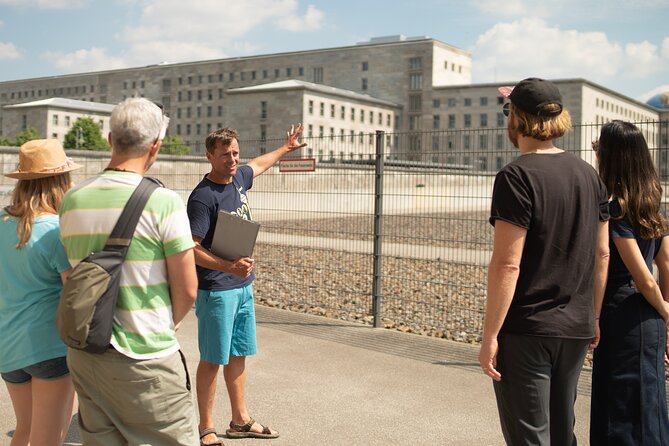
You’ll spend time around Wilhelmstraße, a central hub for Nazi leadership buildings, including the Ministry of Foreign Affairs, the Reich Chancellery, and the Ministry of Propaganda. The guide explains how this area functioned as the nerve center for military strategies and persecution.
Then you connect that to air power at Göring’s former Air Ministry, known as the Reichsluftfahrtministerium. This stop is a reminder that the Nazi war effort ran on more than brute force. The Luftwaffe coordinated major operations, and the building’s grand design is tied to that sense of authority and intimidation.
If architecture fascinates you, pay attention here. The tour doesn’t treat buildings as neutral scenery. It ties the look of power to how the regime wanted people to feel.
More Third Reich history tours:
- Berlin’s Best: 2 Hour Walking Tour Third Reich and the Cold War
★ 5.0 · 5,486 reviews - Berlin: Third Reich, Hitler, and WWII Walking Tour
★ 4.9 · 1,757 reviews - Berlin Third Reich Sites: Half-Day Walking Tour
★ 5.0 · 835 reviews - Berlin: History of the Third Reich Guided Walking Tour
★ 4.7 · 791 reviews
Topography of Terror at the end: why SS and Gestapo matter to the whole story
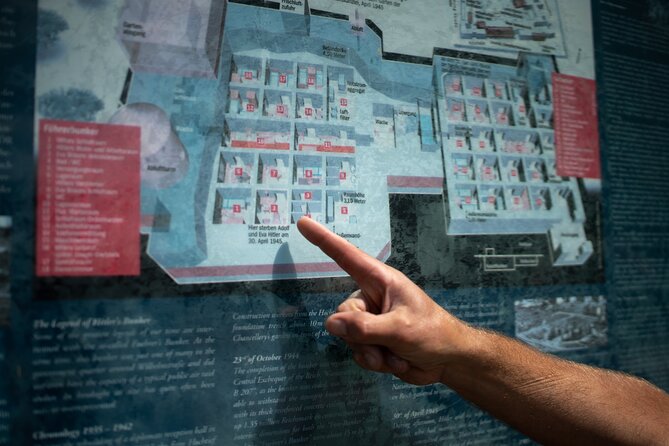
By the time you finish near Topography of Terror, you’ve seen enough key sites that this museum and memorial can land with weight. This stop focuses on the role of the SS and Gestapo in Nazi repression, persecution, and the Holocaust.
You’ll see exhibitions built on the former SS and Gestapo headquarters site, using photographs, documents, and accounts to show the cruelty of state-sponsored terror. You’re not just learning what happened. You’re seeing how a system carried out violence step by step.
It’s also a good closing point because the tour’s earlier stops deal with power, war, and public messaging. This one brings you back to enforcement, fear, and the day-to-day reality of terror.
Stop 2: Trains to Life, Trains to Death, and the Holocaust through forced routes
One of the most moving stops is Trains to Life, Trains to Death. This memorial addresses the deportation of Jews from Berlin to Nazi concentration camps during WWII.
The tour frames it as forced movement, not transport. That detail matters. You walk away thinking about how ordinary infrastructure became a tool for mass murder, using trains as the bridge from home to captivity.
You’ll spend about 10 minutes here, which is enough time to read the core ideas without turning it into a rushed checklist. If you want the full emotional impact, stay present for the first few minutes instead of trying to photograph everything right away.
The Reichstag: from the 1933 fire to the 1945 Soviet flag
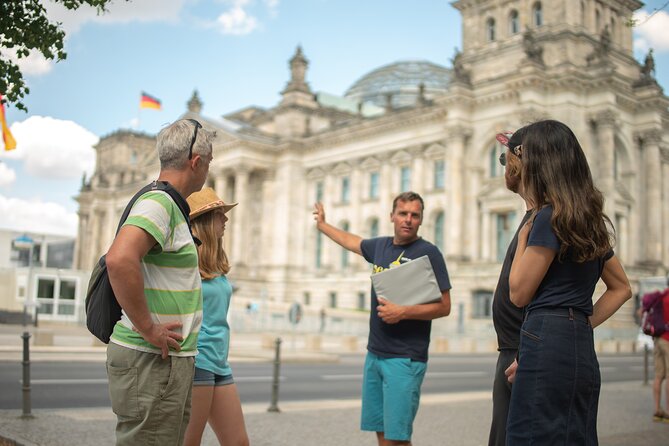
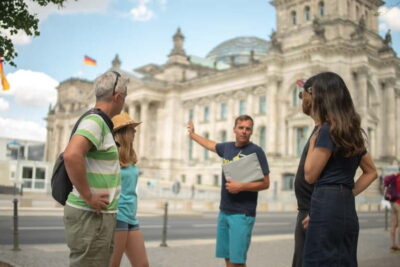
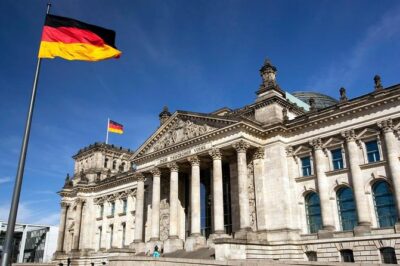
Few places in Berlin carry as much political symbolism as the Reichstag. You’ll stop here for about 15 minutes, but it’s also worth knowing the tour does not include admission to the building. You can still understand the story from the outside, and if you want to go in, you’ll need to handle that separately.
The guide explains the 1933 Reichstag fire as a pretext the Nazis used to consolidate power and dismantle democracy by suspending civil liberties.
Then the story flips to the end: during the final days of WWII, the Soviet flag was raised over the Reichstag after intense fighting in Berlin. So the site becomes a single-location timeline, with democracy’s collapse on one end and Nazi defeat on the other.
If you’ve ever wondered how quickly political systems can be damaged, this stop will put a fine point on it.
Fuhrerbunker: standing above Hitler’s last days in April 1945
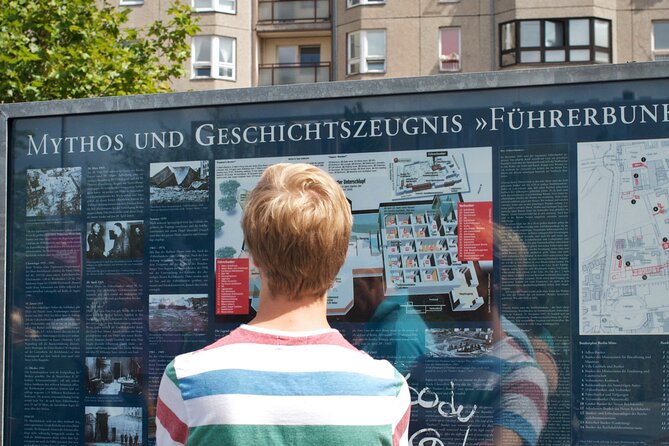
At Fuhrerbunker, you stand above the location where Hitler spent his last days, April 1945. The tour ties the site to the former Reich Chancellery too, connected to Albert Speer’s work.
This stop is short, around 10 minutes, but it’s emotionally heavy for a reason. You’re not just learning about a bunker. You’re learning about what failure looked like from inside power itself.
Guides often handle this part carefully, and the best ones make it clear that this is not “dark tourism.” It’s a way to understand how regimes end, and how decisions made earlier shaped the final outcome.
Soviet War Memorial in Tiergarten: victory with a burial ground attached
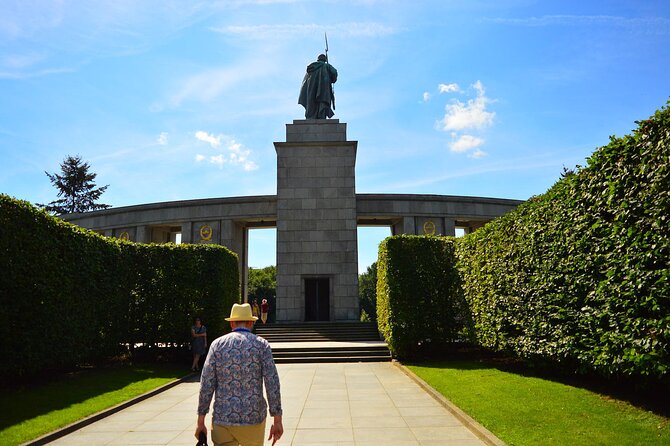
The tour then shifts into the Allied picture with the Soviet War Memorial in Tiergarten. You’ll spend about 15 minutes here.
This memorial honors Soviet soldiers who fought and died in the Battle of Berlin. The statue shows a Soviet soldier holding a flag, standing over two fallen Nazi soldiers, with the surrounding military cemetery making the human cost unmistakable.
The tour uses this moment to explain what Soviet power meant in the last stage of the war, without turning it into a propaganda contest. That balance helps you process the idea that “victory” still comes with tragedy and loss.
If you’re sensitive to cemeteries and war imagery, take a slower pace through this stop. It’s not a place to sprint for photos.
Brandenburg Gate, swastikas, and the regime’s public theater
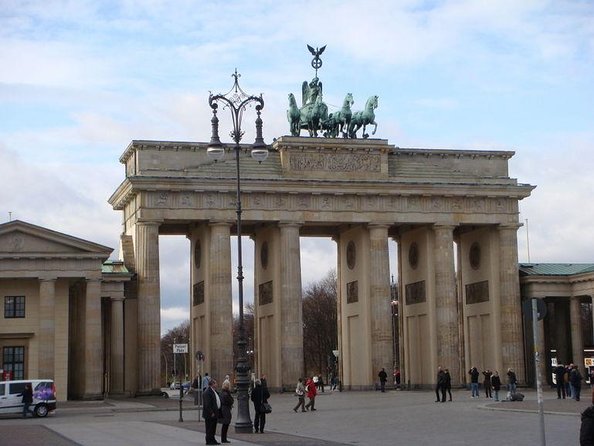
You also visit the Brandenburg Gate, one of Berlin’s most iconic landmarks, and you see it through the Third Reich lens. The tour explains how after Hitler’s rise to power, the gate became part of Nazi public events and rallies.
You’ll hear about the gate being adorned with swastikas during that era, functioning as a backdrop for grand displays of authority.
Today, the gate is tied to German reunification, which creates a built-in contrast. That’s not just history trivia. It’s a real reminder that places can be repurposed by whoever holds power.
Akademie der Künste and Albert Speer: when architecture helps sell ideology
Another stop that adds a different kind of insight is Akademie der Künste (Academy of Arts). The tour connects this area to Albert Speer, Hitler’s chief architect and Minister of Armaments.
Speer’s influence shaped the Third Reich’s architectural vision, promoting monumental neoclassical designs meant to project power and authority. The tour also notes that after the war, institutions tied to that period faced reckoning, and the academy now works as a contemporary arts space while still carrying discussion around its ties.
This stop is useful if you tend to think of the Third Reich as only military and political. It reminds you that ideology also used design, staging, and cultural messaging.
Holocaust Memorial slabs and Topography of Terror: two different ways to remember
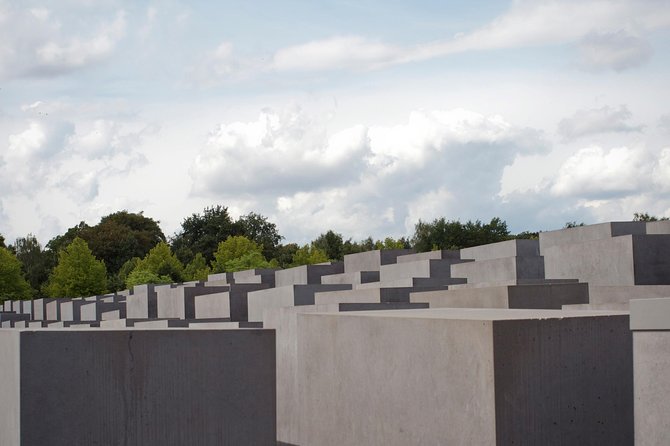
You’ll also stop at the Memorial to the Murdered Jews of Europe, known for its field of 2,711 concrete slabs. The design creates disorientation as you walk the pathways, which is exactly the point: it forces you to feel unsettled rather than simply observe.
Then, at Topography of Terror, the experience becomes documented and historical. One stop leans on physical emotion and spatial experience. The other leans on evidence, records, and what SS and Gestapo carried out.
Together, they keep your brain from treating this as one-note tragedy. You see different memory tools, each with their own purpose.
Price and what you actually get for $24.07
At $24.07 per person for about 3 hours, the value is strong if you want context and efficient routing. You’re paying for a guide, a focused path through key locations, and a format that avoids the common trap of wandering Berlin and only catching the obvious highlights.
Most stops in the walk are marked as free admission, including several major memorials and museums on the route. The one notable exception is the Reichstag Building admission, which is not included. Even so, you still get the narrative and the key exterior context.
Max group size matters too. With up to 25 people, you generally get more room for questions than you would on a huge bus tour. That question time is often where the guide’s strengths show, especially when they connect the political rise of the Nazis to later wartime choices and resistance attempts.
What to wear, how to handle cold, and how to make the walk enjoyable
Because so much is outdoors, your clothing choice affects your whole day. Layer up, wear shoes you can walk fast in, and treat winter Berlin like a real endurance test.
If you need practical planning: keep your phone battery charged for maps and notes, and bring a small drink if you tolerate cold better with something in your hand. The tour is short enough that you can get through it comfortably if you dress for weather instead of for comfort at home.
Also, keep in mind the emotional temperature. This is a WWII and Holocaust-focused route. It’s not all grim in the same way, but it is heavy overall, and that’s part of why it’s worth doing with a guide who can pace the story.
Who should book this tour, and who might want to skip it
This is a strong fit if you want:
- A structured route through Nazi Berlin’s command areas and Berlin’s end-of-war landmarks
- Clear connections between propaganda, government, military power, and resistance
- Memorial stops that keep Holocaust history in view
It might be less ideal if you:
- Want a casual, sightseeing-only afternoon
- Don’t handle emotionally difficult topics well
- Struggle with walking outdoors in cold weather
Should you book? My honest recommendation
If you’re spending limited time in Berlin and want one guided walk that connects Third Reich power to the final collapse, I think this is worth booking. The route doesn’t just point at famous spots. It gives you names, motives, and consequences, including resistance figures like Henning von Tresckow and Claus von Stauffenberg, so you understand the bigger picture.
My main caution is not about the facts. It’s about your comfort with heavy history and cold walking. If you’re ready for both, this is an efficient, high-impact way to experience Berlin’s WWII story on foot.
FAQ
What is the duration of the tour?
The tour lasts about 3 hours.
Where does the tour start and end?
It starts at Reichstagufer 17, 10117 Berlin and ends near Topography of Terror at Niederkirchnerstraße 8, 10963 Berlin.
Is the tour in English?
Yes, it is offered in English.
Are admission tickets included?
Most stops are marked as free, but admission for the Reichstag Building is not included.
How many people are in a group?
The tour has a maximum of 25 travelers.
What should I do before the tour begins?
You should arrive at the meeting point 15 minutes before the start time.
Is the tour mobile-ticket friendly?
Yes, you receive a mobile ticket.
Is it suitable for most travelers?
Most travelers can participate, and service animals are allowed. The tour is near public transportation.
Can I cancel and get a refund?
You can cancel for a full refund up to 24 hours before the experience starts. If you cancel less than 24 hours before, the amount paid is not refunded.
Fresh reviews out of Berlin
- Berlin Uncensored: A History of Sex & Freedom★ 5.0 · 50 reviews
- Berlin Food & Cultural Tour: Must-Try German & Berliner Classics★ 5.0 · 51 reviews
- English Comedy Show with Pizza and Shots in Central Berlin★ 4.5 · 51 reviews
- Rude Bastards Tour of Berlin★ 4.8 · 51 reviews
- Private Taxi Tour of Berlin East and West and Neighbourhood approx. 4-6h★ 5.0 · 55 reviews
- Rickshaw Sightseeing City Tours Berlin – Rikscha Tours★ 4.0 · 55 reviews
- Berlin: City Highlights Express & Panorama Roof Terrace★ 4.9 · 55 reviews
- Berlin during Nazism – Tour in Italian★ 5.0 · 56 reviews
Third Reich & WWII Tours, compared.
Berlin’s Best: 2 Hour Walking Tour Third Reich and the Cold War
Read our review →
Walking Tour of Former Nazi Party Rally Grounds
Read our review →
Berlin Third Reich Sites: Half-Day Walking Tour
Read our review →Browse the lists this tour appears in