
Reviewed · THIRD REICH & WWII TOURS
Nuremberg Old Town and Nazi Party Rally Grounds Walking Tour in English
Nuremberg is one of those rare German cities where WWII history and centuries of everyday life sit side by side. This walking tour also gives you a guided thread through the city’s Old Town, then takes you out to the Nazi-era sites so the story has a place to land. It’s a heavy topic, but it’s taught in a practical, route-based way.
Two things I really like: the public transportation is included, so you are not hunting for buses after a long walk, and the guide helps you read the city. I also love that you get time at major landmarks, from timber-framed streets and medieval walls to the rally grounds and the Documentation Center.
One possible drawback: you will be walking, including uphill toward the castle area, and if you’re easily bothered by crowd noise or you struggle to hear, it can be an issue on busier days.
Key highlights worth planning around
- Old Town first, rally grounds second, so you don’t feel like you’ve jumped straight into the hard stuff.
- Public transport included, which keeps the day smooth instead of splitting your attention between transit and sightseeing.
- City Walls around 4 km long, with viewpoints that make Nuremberg feel like a real medieval fortress.
- Congress Hall area and Great Street, where the Nazi party’s grand plans meet the uncomfortable reality of what’s actually there today.
- Optional longer visit at the Documentation Center, if you want more context around the Nuremberg Trials.
- Small group size (max 25), which is big enough for energy but usually small enough to hear your guide on the move.
Why Nuremberg works so well for a WWII plus Old Town day
Nuremberg’s story is not just about one era. You see it in the stone and street plan, then you see it again in what the Nazi leadership tried to build into the city’s future. That back-and-forth matters. Without it, the rally grounds can feel like a separate “site visit.” With it, the history connects to the place.
The Old Town portion is the part that helps your brain warm up. You walk through medieval lanes, you spot craft traditions, and you learn why this city stayed important long before the 1930s. After that, the rally grounds land with more meaning, because you understand what the Nazis were trying to stage and control.
If you are a history buff, you will like the balance. If you are not, you still get a great walk and strong city orientation. It’s not just facts dumped at you, it’s a route that teaches you what to notice.
More Walking Tours in Nuremberg
- Nuremberg: Old Town Guided Walking Tour
★ 4.6 · 2,416 reviews - Nuremberg: Walking Tour of Former Nazi Party Rally Grounds
★ 4.7 · 1,665 reviews - Nuremberg Old Town and Nazi Rally Grounds Walking Tour
★ 4.7 · 377 reviews
Meeting at Nürnberg Hbf, then getting into a 4-hour rhythm
The tour starts in front of Nürnberg Hbf at Bahnhofspl. (the main train station area). You meet your guide and the group there, then you head into the Old Town on foot.
The tour is about 4 hours, and the pace is a real mix of sightseeing and transit. There’s also a short lunch break in the middle of the day at the market area, which is a big deal because you are not paying extra for a meal that you have not budgeted for.
Group size is capped at 25, and in practice you’ll be moving with a real group dynamic, not a private drift. One thing I’d watch: there isn’t a guaranteed sound system. On louder days, you’ll want to position yourself closer to the guide when you can.
Old Town morning: timber-framed streets, Handwerkerhof, and Hauptmarkt
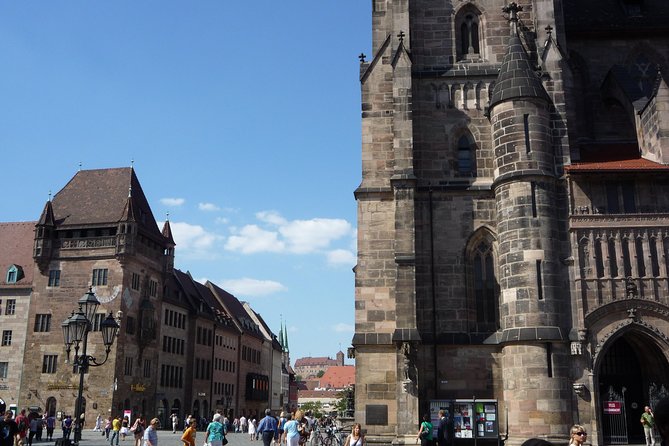
You start where many visitors naturally begin, near the main station, then you work your way through the core of the Old Town. This is where Nuremberg shows its everyday face. Timber-framed houses, cobblestones, and the kind of small-town scale that makes the larger history feel less abstract.
Handwerkerhof is the first stop. It’s a reproduction of a traditional craftsman market, with shopfronts and places to eat. I find these areas useful because they give you a simple entry point into how craft culture shaped the city.
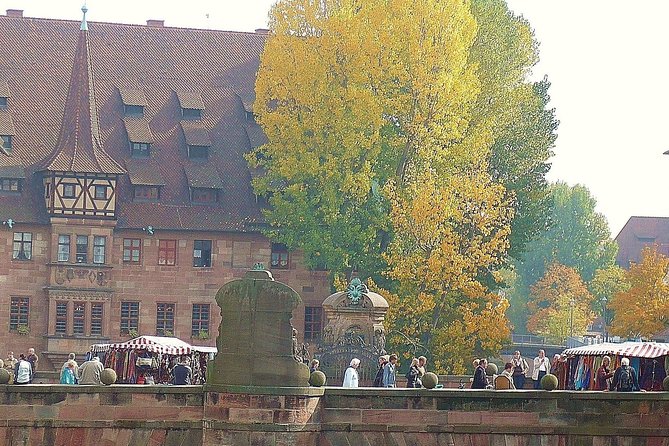
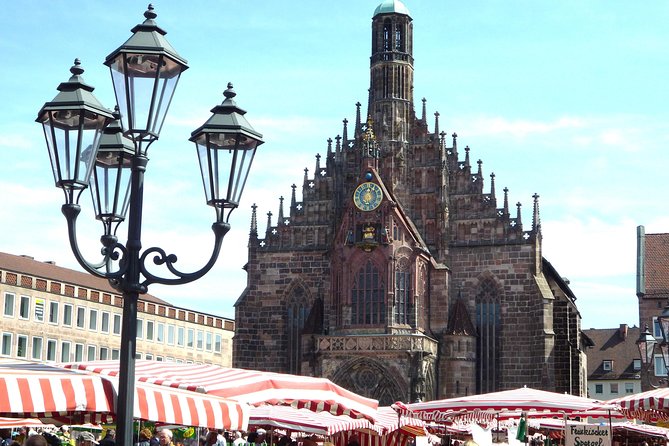
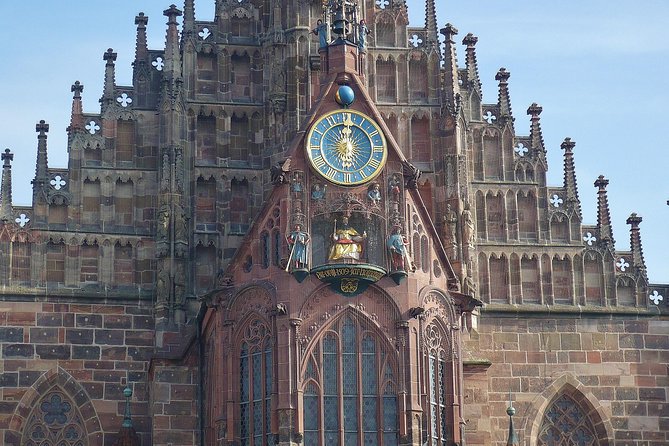
Then comes Hauptmarkt, the main market square that’s been a city center since the 1300s. This is not a random plaza you pass through. It’s the kind of place where you can imagine weekly routines, trades, and public life happening over and over for centuries. You’ll also get that short lunch break around the market area, so you can keep the day moving instead of losing time hunting for food.
A practical tip: wear shoes you can walk in for real. Cobblestones are charming until you’re huffing uphill. The Old Town portion is the part where your legs do most of the work.
St. Sebaldus, the Beautiful Fountain, and the places where art and faith intersect
Next you get several quick but meaningful stops that show how layered the city is. These are short “pop-in” moments, but each one is tied to the bigger story your guide is building.
You’ll see St. Sebaldus Church, the patron-saint church and one of the oldest churches in Nuremberg. The exterior and surrounding area are the focus of the stop, and admission is not included, so plan on just enjoying what you can from outside unless you choose to pay separately.
Then there’s Der Schöne Brunnen, the Beautiful Fountain with its golden Gothic tower and the famous wishing ring. Even if you skip the legend, it’s a fun visual reset. A fountain in a historic square helps your eyes recover between more serious architecture.
You’ll also pass Altes Rathaus (Old Town Hall), finished in 1622. Renaissance and medieval Nuremberg can look similar at a distance, so points like this help you learn to spot the time period in the details.
Finally, you may visit the original house of Albrecht Dürer, now a museum. It’s a sharp reminder that this city produced artists and craftsmen who mattered beyond local borders. If art is your thing, this is the kind of stop you’ll want to linger near, even if your time is limited.
More Third Reich history tours:
- Nuremberg: Historischer Kunstbunker WWII Art Bunker Tour
★ 4.8 · 921 reviews - Nuremberg Third Reich Tour in Spanish
★ 5.0 · 355 reviews - Nuremberg WWII Tour, Courtroom 600 and 3rd Reich Sites
★ 4.5 · 151 reviews - PRIVATE Nuremberg Trials & Rally Grounds Tour
★ 4.5 · 95 reviews
The castle approach and why the walls matter more than you expect
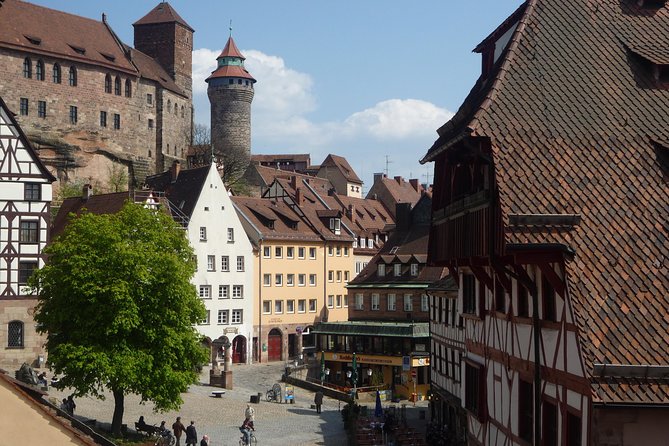
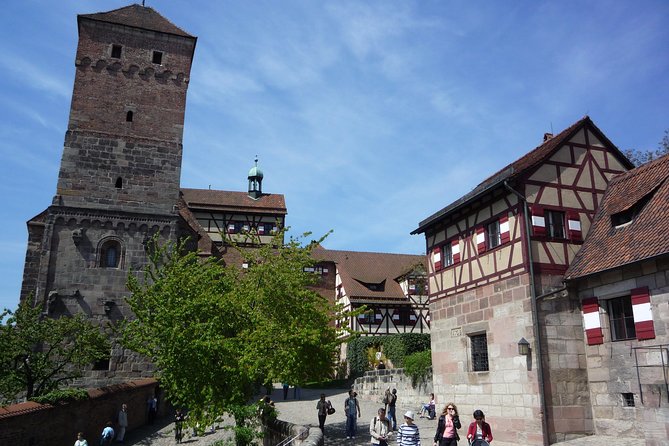
One of the biggest payoffs of this tour is that you reach the Kaiserburg Nürnberg area, with the Imperial Castle dating back to at least 1050. It’s not just a “look, a castle” stop. It’s a chance to understand why a city like Nuremberg needed fortifications in the first place.
Many visitors underestimate how much uphill there is. In the reviews I’ve read, people specifically mentioned the climb. If you’re traveling with knee issues or you don’t like steep walks, you should think carefully before booking a walking-heavy day. You can still do the tour, but go in with the right expectations.
You also get to think about the city walls. The walls still run for roughly 4 kilometers, and the guide’s route helps you grasp that Nuremberg was a real fortress, not just a pretty old town. If your guide is someone who likes storytelling and practical “look here” moments, you may even get a quick extra angle from the wall areas, like a short viewing opportunity above the street level.
Shifting gears: riding to the Nazi rally grounds (and why the transit is useful)
After the Old Town portion, you hop onto public transportation (bus or train) included in the tour. This matters because the rally grounds are not right next to the medieval center. You get a planned transfer instead of scrambling on your own.
Expect a short ride and a change of atmosphere. One review noted around 20 minutes by bus, which fits the feeling of a quick reset rather than a long commute. Either way, you will arrive with your head already in “history mode,” not scattered between transit and facts.
If you hate wasted time, this part is good. You’re not stuck waiting around. You’re moving, and your guide keeps the story moving as the architecture changes.
Great Street, Congress Hall, and understanding the scale of the plans
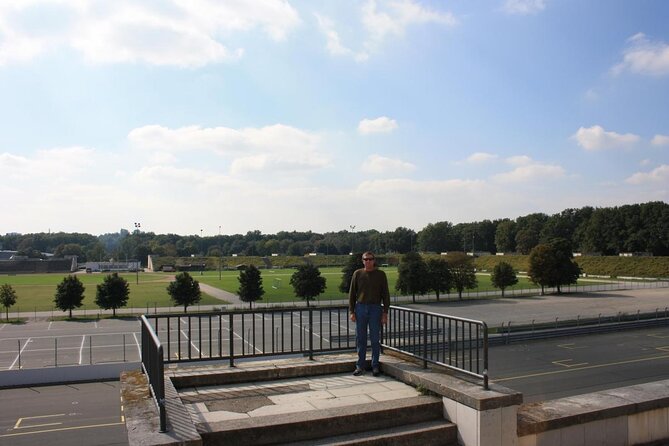
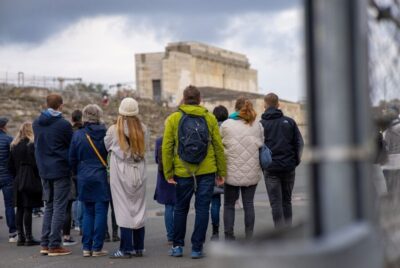
At the rally grounds, you’ll see key elements of the Nazi party staging area, including the Great Street designed as a central axis by Albert Speer. This is one of those places where the layout does the explaining. Even if you’ve never studied architecture, the street grid and monumental scale communicate power.
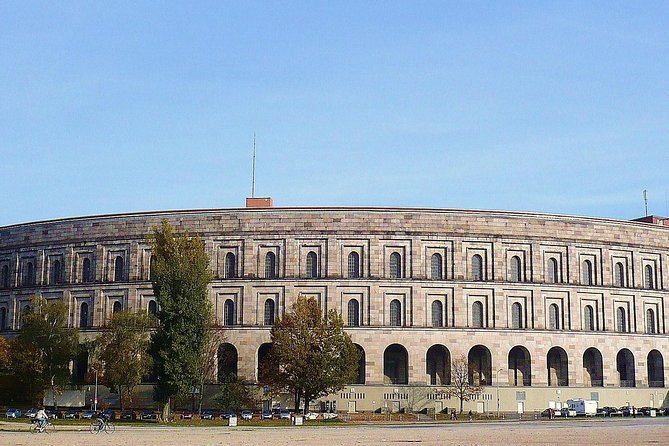
You’ll also see the Congress Hall, which was planned for party meetings and remains unfinished. I find it helpful that the tour talks about what was intended versus what ended up built. The mismatch makes the site easier to process, especially for first-timers.
Another stop is Volksfestplatz, Nuremberg’s fairgrounds area that the Nazis used for the rallies. It’s a reminder that these were public-facing events in a real city space. The tour helps you connect the “spectacle” idea to the geography around you.
One thing to know: the rally grounds look different today than they did in the Nazi era. If you expect perfectly preserved mega-sets, you might feel slightly disappointed. But in my view, that’s part of what makes it meaningful. You see propaganda plans collide with time, and that’s a key lesson.
The Documentation Center: where the tour earns its emotional weight
The Documentation Center is the museum component that gives context around wartime and post-war events, including the Nuremberg Trials. Your tour gives you a chance to stop there, and you can stay longer if you want deeper exhibits.
This is the part where I’d slow down. You don’t just want to see buildings tied to atrocities. You want to understand how the world responded afterward, and how history was judged and recorded. The Documentation Center is built for that kind of grounding.
If you are the type who likes to read at your own pace, consider spending extra time here. If you’re short on energy, even a focused visit will help connect the rally grounds to the trial history, which is the hard hinge of the story.
Who this tour is best for, and why the $44.74 price can be solid value
At $44.74 per person for about 4 hours, this tour is priced for people who want a guided route and don’t want to piece together tickets and transit. The big value point is that you get both a local guide and public transport included, so your day’s costs are more predictable.
You also get a blend that’s hard to reproduce solo. Walking the Old Town with context, then transferring to the rally grounds with an explanation for what you’re looking at, is exactly the kind of “guided coherence” that makes a trip feel organized.
This is a good fit if:
- you like WWII history but you also want the Renaissance and medieval city flavor
- you want an efficient first-timer overview of Nuremberg
- you prefer learning from a route, not a museum-only plan
From the guide names I’ve seen in the experience feedback, the quality of storytelling can be a big part of the day. People have highlighted Natasha for being friendly and knowledgeable, Hannes (John) Ziener for exceptional organization and enthusiasm, and Nick or Nikolas for engaging, humorous delivery and pacing that keeps the group together. One guide, Dimitri, also earned praise for making the medieval section less dry with extra details.
If you’re a quiet learner who wants a slower pace, you may prefer a different format. But for many people, this is the right mix of movement and meaning.
Practical issues to plan around: hearing, crowds, and walking uphill
The most common real-world friction points are not about history content. They’re about logistics.
First, you should plan to walk uphill. Multiple people specifically warned about the climb toward the castle area. If your mobility is limited, you might still manage it, but you should factor in time and energy.
Second, sound can be tricky. One comment asked for a louder voice and pointed out that a large group without a sound system can make it hard to catch details. The tour is capped at 25, but “can hear everything” is still dependent on where you stand and how crowded it is.
Third, crowds can change the vibe. One person specifically noted that Saturdays during the Christmas market season are busy and loud. If you’re sensitive to noise or you want a calmer experience, consider weekdays.
Finally, food is not included. The tour includes a lunch break, but you are paying for what you eat.
My booking verdict: should you do this Nuremberg Old Town and rally grounds tour?
If you want a single day that connects medieval Nuremberg, Renaissance art, and the Nazi party rally grounds in one logical arc, I think you’ll like this. The best part is the structure: Old Town first for orientation, rally grounds next for the hard chapter, and then the Documentation Center to add context and closure.
Skip this only if you strongly dislike walking, you need guaranteed quieter audio in crowds, or you only want either Old Town or rally grounds, not both. Otherwise, book it and show up with comfortable shoes and a head ready for uncomfortable history.
FAQ
What is the tour duration?
It’s listed as about 4 hours.
Where does the tour start?
The meeting point is in front of Nürnberg Hbf at Bahnhofspl., 90443 Nürnberg, Germany.
Is the tour offered in English?
Yes. It’s offered in English.
Is a mobile ticket provided?
Yes. The tour includes a mobile ticket.
Does the price include public transportation?
Yes. Public transport (bus or train) is included as part of the tour.
What is not included in the tour price?
Food and drinks are not included. Also, admission for St. Sebaldus Church is not included.
Will I have time at the Documentation Center?
You can choose to stay longer at the Documentation Center if you want.
How large is the group?
The maximum group size is 25 travelers.
Is the tour weather dependent?
Yes. The experience requires good weather, and if it’s canceled due to poor weather you’ll be offered a different date or a full refund.
Fresh reviews out of Nuremberg
- Tour to Rothenburg ob der Tauber from Nuremberg in Spanish★ 5.0 · 51 reviews
- Nuremberg: World War II Tour with Hotel Pickup★ 4.4 · 51 reviews
- Nürnberg: Mörder, Fälscher, Messerstecher★ 4.8 · 53 reviews
- Nuremberg Ghosts and Gallows Evening Walking Tour in English★ 5.0 · 56 reviews
- Nuremberg’s Mystery Morning: Breakfast & Escape Game★ 4.4 · 57 reviews
- Nuremberg: Private Walking Tour with a Local★ 3.8 · 77 reviews
- Nuremberg World War II★ 4.5 · 89 reviews
- Nuremberg Private Walking Tour: Old Town and Nazi Rally Grounds★ 5.0 · 92 reviews
Third Reich & WWII Tours, compared.

Berlin’s Best: 2 Hour Walking Tour Third Reich and the Cold War
Read our review →
Third Reich Berlin: Hitler and WWII Walking Tour
Read our review →
Walking Tour of Former Nazi Party Rally Grounds
Read our review →
Browse the lists this tour appears in