
Reviewed · WALKING TOURS
Berlin Highlights Private Guided Walking Tour
Berlin is fascinating because you can walk through huge political shifts in just a few city blocks. This private route stitches the landmarks together with the stories behind them, so you do not just see famous places, you understand why they mattered.
I love the crowd-smart pacing. You move in a tight loop between major sights, and the private format makes it easier to pause for photos, questions, and slower moments.
I also like that the guides tailor the tour pace and interests, like history, photography, and culture. The main consideration: it is still a walking tour, so if your knees or legs are touchy, you should plan for a full half day on foot.
Key highlights to expect
- Private, small-group feel: up to 15 people, and only your group participates
- WWII to Cold War to reunification, in order: you connect stories stop to stop, not as random facts
- Major free sights: stops are listed as admission ticket free
- Pickup is possible: your guide can meet you at your accommodation or a chosen meeting point
- Photo stops built in: guests mention time for pictures and flexible pacing
- Real Berlin context, not just monuments: Cold War corners, power symbols, and memorial meaning
A Berlin highlights route that makes sense in 4 hours
This tour works best if you want the big names, but also want the thread that ties them together. Berlin did not have one straight storyline across the 20th century, it had a few brutal chapters that overlap. Doing the landmarks in a logical walk helps your brain build a map.
The route is also designed for energy. You get a steady sequence of iconic exteriors, memorials, and squares you can actually stand in, not just glance at from a bus window. Even with a packed day, it still feels like a walk through the city you can absorb.
And because it is private, you are not stuck with a fixed group rhythm. In past tours, guides like Loana, James, Ben, Johnny, Pip, Marcos, and Joana have been praised for adjusting to the group and handling questions with patience, including families and people who wanted more time at photo spots.
One heads-up: the duration is listed as about 4 hours, but at least one guest reported it ran closer to 3 hours. That can happen if your guide’s timing and the group’s pace line up differently, so I suggest you plan your day with a little flexibility afterward.
More Walking Tours in Berlin
- Discover Berlin Half-Day Walking Tour
★ 5.0 · 9,624 reviews - Berlin: Third Reich and Cold War 2 Hour Walking Tour
★ 4.9 · 6,830 reviews - Berlin: Discover Berlin Walking Tour
★ 4.9 · 5,998 reviews
Pariser Platz: the elegant start that frames Brandenburg Gate
You begin at Pariser Platz, a prestigious square that sits right at the end of Unter den Linden. It is a strong starting point because it sets your eye line: you are aligned with a major symbol of Berlin’s story.
From here, it is easy to understand why Brandenburg Gate became so important. In Prussian times it was a royal entrance, and in the modern city it has repeatedly been recast by whoever held power. Starting at Pariser Platz also means you are starting with a wide, open view, great for getting oriented fast.
If you like photography, this area is useful because you can shoot from multiple angles without feeling rushed. It also helps you settle into the walk before the story shifts into darker ground.
Reichstag and the glass dome: power, control, and a changed building
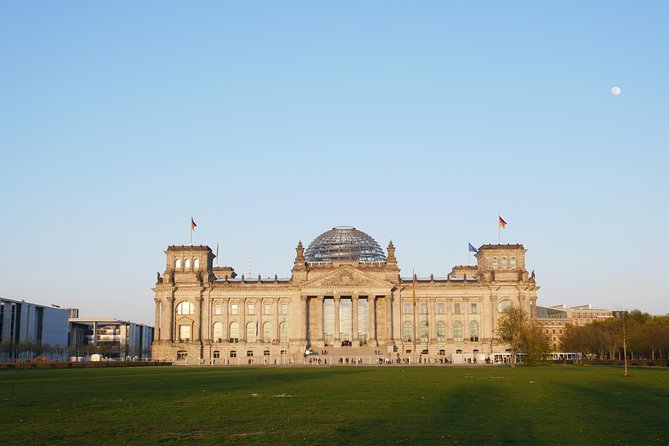
Next you head toward the Reichstag Building, Germany’s parliament. The building has one of those historical links that people always mention because it changed politics fast: the fire that helped enable Hitler’s rise to total control.
What I like about stopping here is that the story is not only about the past. The Reichstag today has a glass copula designed by British architect Sir Norman Foster, and that detail is a visual reminder that Germany has built new layers over old trauma.
This is also a stop where a good guide really matters. Without explanations, it is a big government building. With the right context, you start seeing the connections between architecture, propaganda, and how a country presents itself after war.
Brandenburg Gate: from division to reunification symbol
Then comes Brandenburg Gate, one of Berlin’s most recognizable monuments. It survived Napoleon and WWII, and it also endured a long period in the middle of the Berlin Wall, for almost three decades.
That trapped location is key. It was not just a background landmark during the Cold War, it became a visual headline. Later, after reunification, it shifted again, turning into a symbol of a Germany brought back together.
For a private tour, the best part is that you can linger. You can also ask for context about what different eras meant for the gate’s message, because the guide can tailor how deep to go.
Another way to spend a Berlin afternoon:
- Berlin: Reichstag, Dome and Government District Guided Tour
★ 4.7 · 18,288 reviews - Berlin: 1-Hour City Tour by Boat with Guaranteed Seating
★ 4.3 · 16,993 reviews - Berlin: TV Tower Standard Entrance Ticket
★ 4.4 · 15,883 reviews - Berlin: Boat Tour Along the River Spree
★ 4.4 · 11,252 reviews
The Holocaust Memorial: where meaning matters more than speed
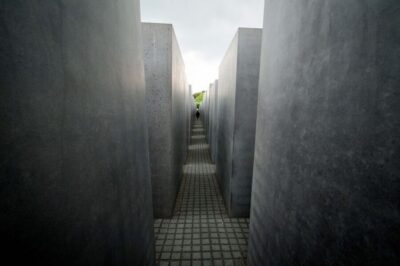
After the gate, the tour shifts to the Holocaust Memorial, Memorial to the Murdered Jews of Europe. This is the massive field of stone stelae, and it functions as Germany’s central memorial for Jewish victims of the Holocaust.
This is not the stop you sprint through. The site asks you to slow down, because the structure and the spacing create a physical feeling you cannot get from pictures alone. You get around 20 minutes here, which is often enough to walk through once and pause for a moment of reflection, but it may feel short if your brain wants longer.
A good guide will strike the balance: factual, direct, and respectful. If you are traveling with younger kids, this is also where you may want your guide to adjust tone, because memorials land differently at different ages.
Fuhrerbunker site and the last chapter of WWII
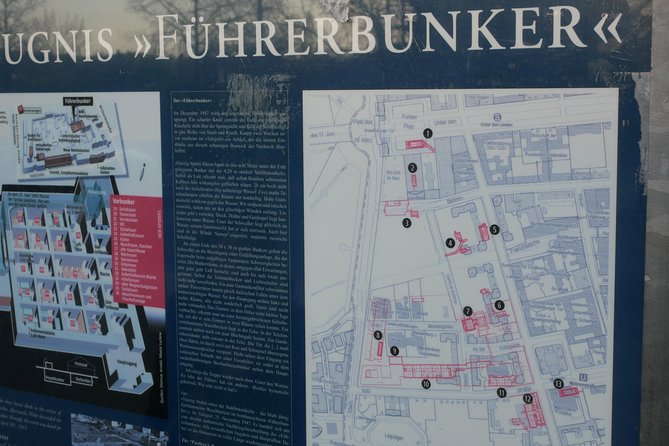
From there you visit the area associated with the Fuhrerbunker. Today it is essentially a parking lot with a simple sign, but it marks the location where Hitler spent his final days, married, and ultimately committed suicide during the final days of WWII in Europe.
It can feel strange that such a heavy place has a normal-looking setting. That contrast is exactly why a stop like this is powerful. Without guidance, you might look for ruins or a dramatic museum. With the story, you understand why the lack of visible structure is part of how Berlin processes the past.
It is also a reminder that Berlin’s history is not only about walls and buildings. It is also about decisions made in specific rooms and shelters, and how fast regimes collapse when reality catches up.
Potsdamer Platz: Berlin’s modern rebuild after total destruction
Then the walk swings toward Potsdamer Platz, which once was one of the busiest traffic intersections in Europe in the 1920s, with more than 20,000 cars crossing each day. WWII destroyed it almost completely.
What you see today is the result of a major rebuilding effort in the 1990s and early 2000s. This stop is great for understanding why Berlin feels so layered. You are not just looking at one era. You are looking at the choices made after the break, and the ambition to build a city that could move forward.
One drawback to keep in mind: because it is modern and busy, it can be louder and harder to get quiet photos depending on the time of day. Still, it is worth it because the contrast with the previous sites lands hard in a good way.
The Berlin Wall memorial stretch: Cold War geography you can feel
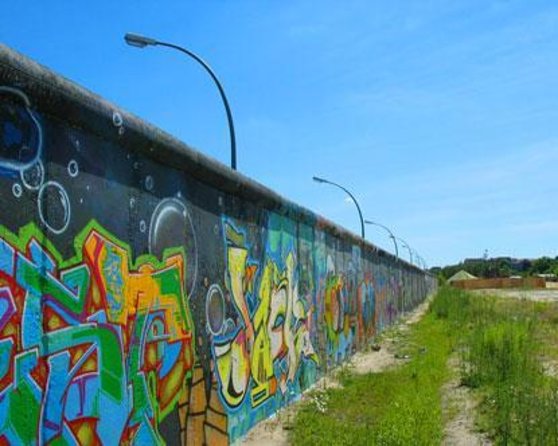
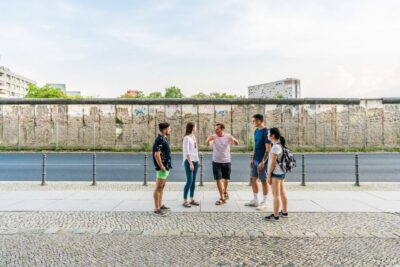
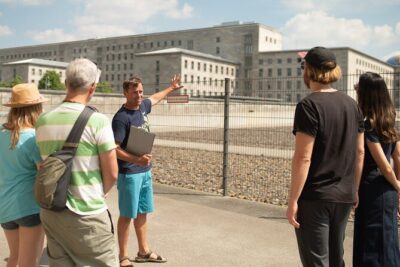
After Potsdamer Platz, you get to the Memorial of the Berlin Wall, with one of the remaining stretches. This segment is especially meaningful because it sits on the site of former SS and Gestapo headquarters, and it is directly across from the monolith former Nazi Luftwaffe headquarters.
That detail is important. You are not just seeing a wall as an abstract symbol. You are standing in a physical grid where different branches of state power once operated, sometimes with chilling proximity.
The time here is about 15 minutes, which is usually enough to walk along the visible section, absorb the location, and hear the Cold War explanation in context. If you prefer quiet, this is a spot where you might step back and take a minute alone, even if your group keeps moving.
Checkpoint Charlie: the Cold War frontline in miniature
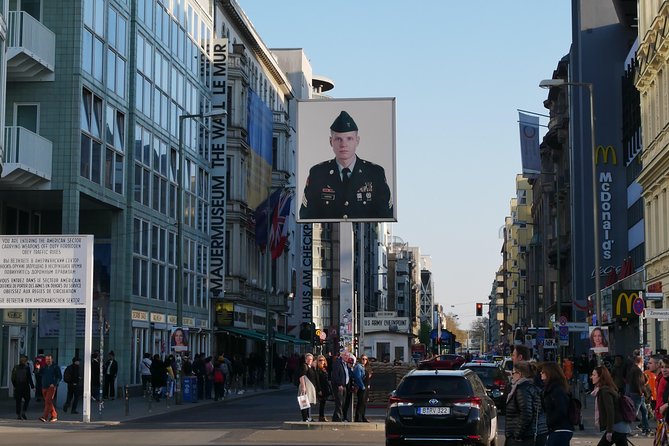
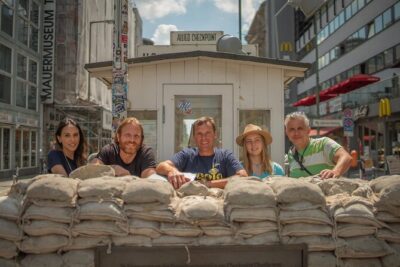
Checkpoint Charlie is next, the famous frontline and Allied checkpoint manned by the Americans and Soviets during the Cold War. It is one of those places where Berlin turns history into an easily recognizable icon.
What makes it useful on a guided walk is the explanation behind the practical reality of checkpoints. Instead of just hearing names and dates, you learn why these crossings mattered, how the city functioned under pressure, and how everyday movement became political.
At about 10 minutes, you can see the key landmarks without losing momentum. It is a quick stop, but a memorable one, especially if you like the mechanics of how history worked on the ground.
Gendarmenmarkt: a beautiful square that still carries weight
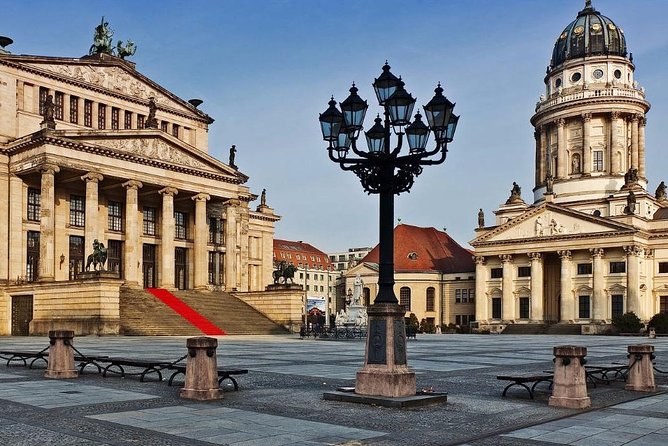
Then you reach Gendarmenmarkt, widely considered one of the most beautiful squares in Berlin. It is home to the French and German Cathedrals and the Konzerthaus, plus gardens and statues that make it feel like a calm pocket in the city.
I like placing this kind of stop mid-tour. It gives your brain a breather after heavy topics. It also lets you see how Berlin can be elegant and theatrical, not only severe and symbolic.
In a private format, your guide can also point out which buildings are which, and how the square fits into the city’s cultural life. Even if you only have a short time, the architecture is worth seeing in person.
Bebelplatz and the 1933 book burnings: when ideas become weapons
Next is Bebelplatz, originally known as Frederick’s Forum, after Prussia’s Frederick the Great. Today it ties together several major cultural institutions, including Humboldt University, the Opera House, the Royal Library, and Hedwig’s Cathedral.
But Bebelplatz also holds one of the most infamous Nazi acts: the book burnings on May 10, 1933. This stop is a strong reminder that censorship is not a side story. It is part of how violence and control spread.
This is a place where a guide’s framing matters. You want clear, respectful context that does not try to shock for effect, but still makes the stakes obvious.
Unter den Linden and Museum Island: the royal boulevard leads to the museum core
After the memorial-heavy stops, you walk onto Unter den Linden, the royal boulevard of Berlin connecting Brandenburg Gate to Museums Island and the City Palace. This is one of the best ways to end a highlights tour because it gives you a simple visual thread across town.
The stroll helps you build your mental map. You can then look back at what you have already seen and connect it to the city’s geography, not just individual monuments.
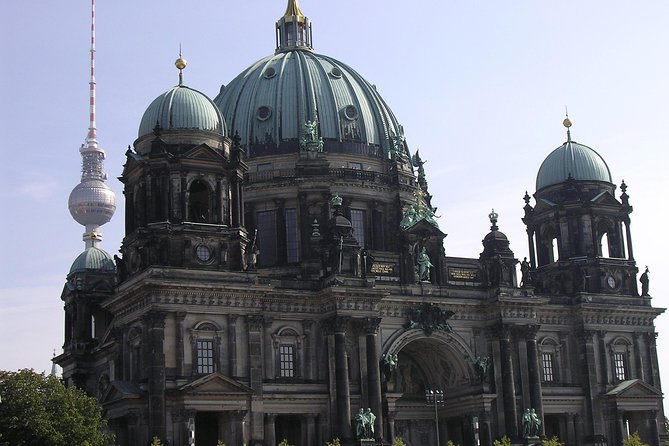
Finally, you reach Museum Island, a UNESCO World Heritage Site with six world-class museums. You also see the Berlin Cathedral and the newly rebuilt Hohenzollern city palace from the broader area.
This stop is listed with about 15 minutes, so it is not a museum day. Still, it is a great capstone because it signals Berlin’s shift toward culture and public life, not only war and division.
Price and logistics: what $417.23 gets you
The price is $417.23 per group, up to 15 people, for about 4 hours. That is not cheap, but private tours in the biggest cities usually are not. The real question is what you get for that cost.
You get value in three places:
- Efficiency. A guide helps you move between the major landmarks without wasting time figuring out routes.
- Context. The stops are closely packed, but the meaning comes from explanations linking them together.
- Flexibility. Private means the pace and priorities can be adjusted, and many guests praised guides for answering questions and finding spots people might miss.
If you are a small group of 2 to 4 adults, the cost becomes easier to justify because you are paying more for the guide’s attention than for a ticket. If your group is bigger, the per-person math improves, as long as everyone can keep the walking pace.
Also, admissions are listed as free at each of the key stops on the route. That helps you avoid surprise ticket fees and makes budgeting simpler.
How to plan your day for a walking half-day
This tour is meant for people with moderate physical fitness. You will want comfortable walking shoes, and you should expect to keep moving through city streets. The route is described as a walking tour experience, and at least one guest complained that the description did not clearly signal the walking amount. So treat it as full-on walking, not a sit-down sightseeing plan.
Pickup is offered, and your guide can meet you at your accommodation or at a chosen meeting point, including areas like Museum Island, Unter den Linden, Bebelplatz, Gendarmenmarkt, and onward along the route. That can reduce stress, especially if you are staying farther from Pariser Platz.
A practical tip: build in buffer time after the tour, even if it runs close to 4 hours. One guest reported a shorter time than advertised, and guide timing can vary based on your group and conditions. You will enjoy this tour more if you are not racing to your next reservation.
Should you book it? My straight answer
Book this tour if you want Berlin highlights with clear historical connections and a guide who can handle questions with patience. If you care about WWII context, Cold War geography, and how reunification reshaped symbols like Brandenburg Gate, this format is a good fit.
Skip it or choose a different option if you need a low-walking plan or you want museums with long indoor time. This is tightly focused on key exterior areas, memorial sites, and major squares, not a deep museum day.
One more thought: because it is private, you get a better chance at tailoring. If possible, message ahead with what you most care about, like photography time, family pacing, or specific historical angles. Guides like Loana, James, and Ben have been praised for doing exactly that, including adjusting pace and taking care of groups with mixed needs.
In the end, this is a high-value way to see the big names of Berlin while understanding what sits behind them. Just go in expecting a walking half-day, not a bus tour, and you will get the most out of every stop.
FAQ
Where does the tour start and where do we end?
The tour starts at Brandenburg Gate, Pariser Platz, 10117 Berlin. It ends back at the meeting point.
Is pickup offered?
Yes. You can be met by your guide at your accommodation or a chosen meeting point before visiting areas including Museum Island, Unter den Linden, Bebelplatz, Gendarmenmarkt, Checkpoint Charlie, the Berlin Wall area, and Potsdamer Platz.
How long is the tour?
The duration is approximately 4 hours.
What language is the tour offered in?
The tour is offered in English.
How big is the group?
It is a private tour/activity, with up to 15 people for the group.
Are the sights included with paid admission?
Admission is listed as free for the key stops on the route (so you typically do not need paid tickets to participate in viewing these areas).
Do I need good walking shoes?
Yes. You should wear comfortable walking shoes, and travelers should have moderate physical fitness for the walking tour.
Is a mobile ticket used?
Yes. The tour includes a mobile ticket.
Can service animals join?
Yes, service animals are allowed.
Can I cancel and get a refund?
No. This experience is non-refundable and cannot be changed for any reason.
Fresh reviews out of Berlin
- Berlin Uncensored: A History of Sex & Freedom★ 5.0 · 50 reviews
- Berlin Food & Cultural Tour: Must-Try German & Berliner Classics★ 5.0 · 51 reviews
- English Comedy Show with Pizza and Shots in Central Berlin★ 4.5 · 51 reviews
- Rude Bastards Tour of Berlin★ 4.8 · 51 reviews
- Private Taxi Tour of Berlin East and West and Neighbourhood approx. 4-6h★ 5.0 · 55 reviews
- Rickshaw Sightseeing City Tours Berlin – Rikscha Tours★ 4.0 · 55 reviews
- Berlin: City Highlights Express & Panorama Roof Terrace★ 4.9 · 55 reviews
- Berlin during Nazism – Tour in Italian★ 5.0 · 56 reviews
Walking Tours, compared.
Berlin’s Best: 2 Hour Walking Tour Third Reich and the Cold War
Read our review →
Third Reich Berlin: Hitler and WWII Walking Tour
Read our review →Browse the lists this tour appears in