
Reviewed · WALKING TOURS
An Introduction to Berlin Walking Tour
Berlin has a talent for turning politics into architecture, and this 3-hour walking tour leans hard into that. I love the small group size and the way it keeps the pace human, not rushed. I also like that you’re seeing major landmarks with a clear thread from Prussian power through 20th-century Berlin.
I really like how the tour uses iconic stops to explain big ideas, not just landmarks. You’ll get the story behind the Reichstag’s glass dome and how it connects to Germany’s democratic moment, then you’ll see how those same themes echo at the places tied to militarism, the Cold War, and the Holocaust.
One possible drawback: you’ll walk, and you’ll also use public transport a few times since some distances are too far for comfortable foot travel in a short window. If you hate transit or you arrive without a plan for tickets, it can slow your day down.
Key highlights to look forward to
- A historian-led walk that links buildings to power, ideology, and everyday life
- Max 8 people, so questions and side explanations actually land
- Major Berlin icons in one circuit, including the Reichstag, Brandenburg Gate, and Potsdamer Platz
- Museum Island stop focused on the Prussian-era museum complex on Spree Island
- The Holocaust Memorial experience, designed as a walk-through space of reflection
- Straight practical guidance on public transport and where to pick up a pass if needed
A 3-hour Berlin walk where politics shows up in stone
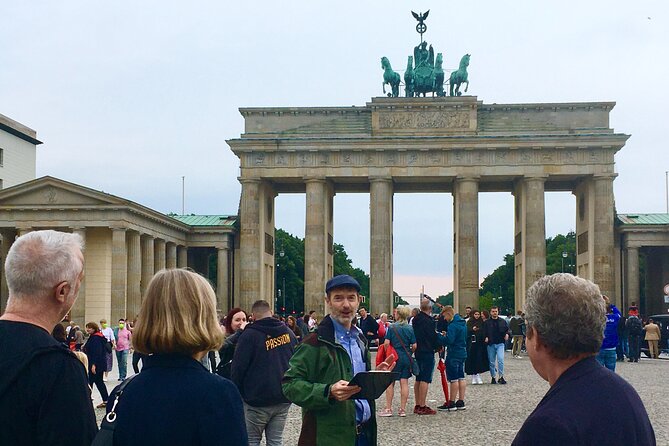
This tour is built around the idea that Berlin’s most famous buildings are never just buildings. They’re messages, written in stone, glass, and layout. Over about three hours, you connect the dots from Prussia’s early militarism to the pressures that shaped 20th-century Berlin, then you end at places that force you to face what happened and what changed.
I like that the pace is tight but not frantic. You’re not spending the whole time inside a museum. Instead, you’re outdoors long enough to build context, then you get guided interpretation so each stop feels earned. It works especially well if you’ve never done a “Berlin history in buildings” type of tour before.
This is also a good format for first-timers because it hits the headline locations you will keep seeing again later. The tour gives you the map in your head, so future self-guided wandering feels easier and more meaningful.
More Walking Tours in Berlin
- Discover Berlin Half-Day Walking Tour
★ 5.0 · 9,624 reviews - Berlin: Third Reich and Cold War 2 Hour Walking Tour
★ 4.9 · 6,830 reviews - Berlin: Discover Berlin Walking Tour
★ 4.9 · 5,998 reviews
Starting at Unter den Linden 42, the easiest way to get your bearings
The meeting point is Unter den Linden 42, 10117 Berlin. It’s a smart spot because it’s already on one of Berlin’s grandest streets, and it helps you start the day with the right mood and scale.
A few practical notes that matter. The tour is offered in English and uses a mobile ticket, so you’re not hunting for paper. It’s also near public transportation, which makes it easier if your hotel is outside the center.
Booking tends to fill, too. If you can, don’t wait until the last day. The tour is commonly booked about 7 days in advance on average, and the group cap is up to 8 travelers (that limit is part of the value, not just fine print).
Reichstag Building: the dome that turns democracy into a view
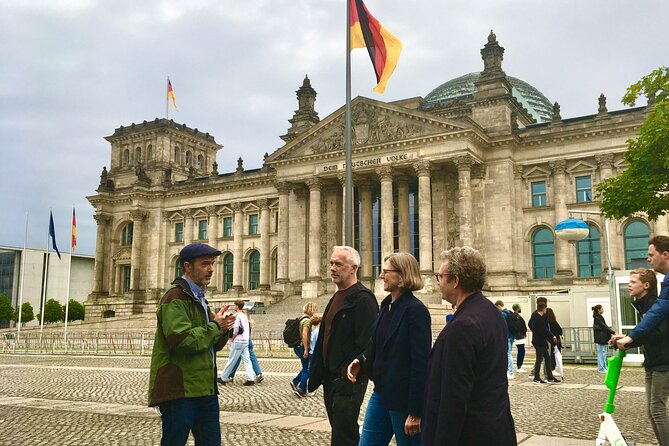
Your first stop is the Reichstag Building, home to the Bundestag. The famous move here is the glass, transparent dome added in the 1990s by Norman Foster. From street level, you see the building’s identity. From the dome concept, you get a different message: democracy is meant to be seen.
This stop is time-boxed at about 15 minutes, and the goal isn’t to linger. The guide’s job is to frame what you’re looking at. You’ll learn that the Reichstag is where Germany’s national legislature meets, and you’ll connect the building’s symbolism to modern government. If you’re into architecture, this is the kind of stop that pays off fast because it turns design choices into political meaning.
Admission is listed as free for this part, which is great for value. One consideration: in peak periods, even with free access, you may feel the pull of lines and crowding. If you’re the type who hates waiting, arrive a few minutes early.
Brandenburg Gate: Prussian power to world headlines
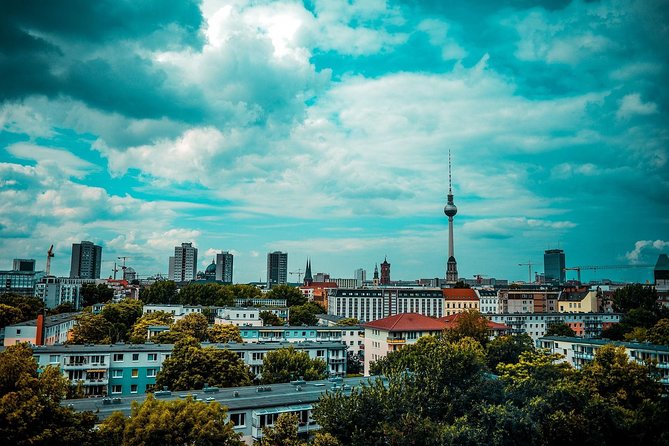
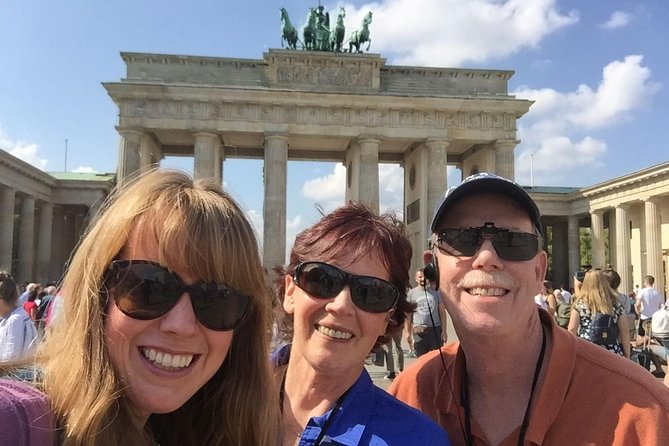
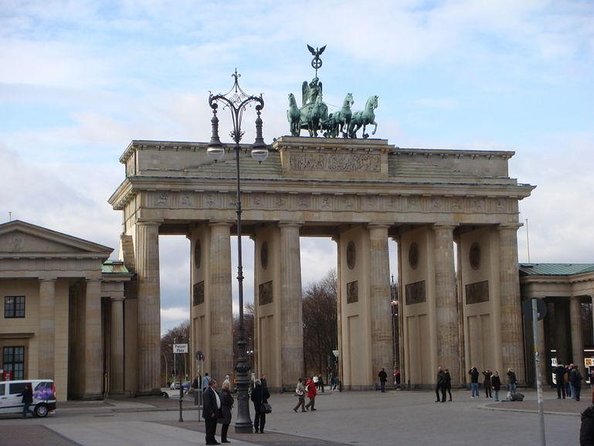
Next up is the Brandenburg Gate, a neoclassical monument built on the orders of Prussian king Frederick William II. It’s one of those places that feels familiar even if you’ve never been, because it appears in so many photos and textbooks.
The tour gives it a timeline. You’ll hear about famous moments connected to the gate, including Napoleon’s triumphant entrance and Ronald Reagan’s Cold War-era speech. That’s the point of the stop: the gate acts like a stage for major turning points.
You get about 20 minutes here, and admission is listed as free. The drawback is simple: since it’s iconic, it can attract crowds. Your best move is to use the time strategically, stepping back to get the full structure, then letting the guide’s story “place” the gate in history.
Another way to spend a Berlin afternoon:
- Berlin: Reichstag, Dome and Government District Guided Tour
★ 4.7 · 18,288 reviews - Berlin: 1-Hour City Tour by Boat with Guaranteed Seating
★ 4.3 · 16,993 reviews - Berlin: TV Tower Standard Entrance Ticket
★ 4.4 · 15,883 reviews - Berlin: Boat Tour Along the River Spree
★ 4.4 · 11,252 reviews
Museum Island: Prussian museums on Spree Island
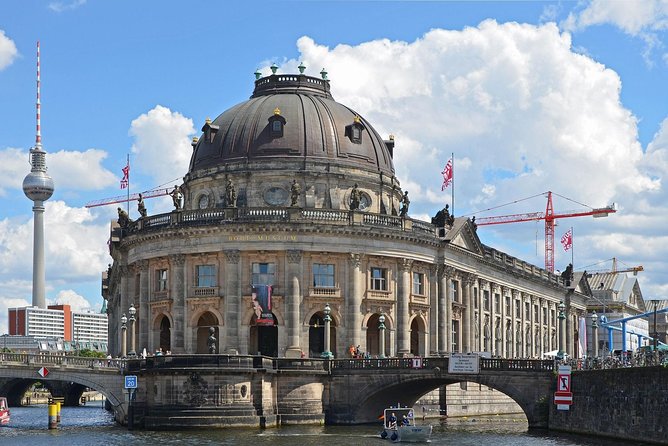
Then you move to Museum Island on Spreeinsel (Spree Island). This ensemble covers five major museums built under Prussian rulers, and the tour spotlights big names like the Pergamon, Neues Museum, and Alte Nationalgalerie.
You’re not doing a deep museum ticket crawl in this stop. Instead, you’re getting the architecture-and-history framing that helps you understand why these collections became national showcases in the first place. In a short Berlin stay, this kind of stop is a lifesaver because it points you toward what to prioritize later if you want to go in.
This stop is about 25 minutes, and admission is listed as free for the viewing portion. One possible consideration: you’ll spend time outdoors, and Berlin weather can change fast. If you’re visiting in shoulder season, bring a layer.
Potsdamer Platz: a square reborn after a hard break
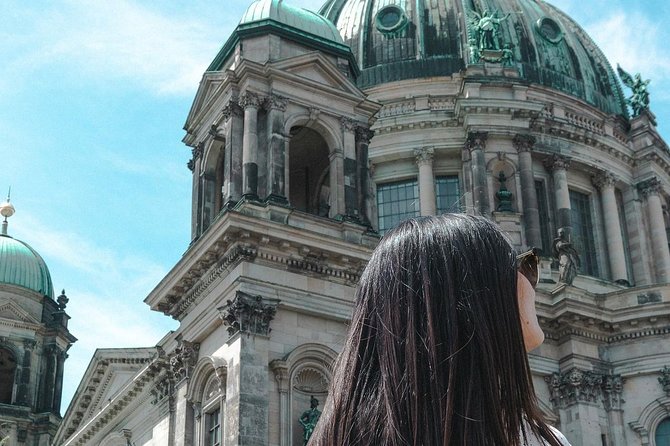
At Potsdamer Platz, you see the Berlin Wall’s shadow without walking directly through wall remains. The story here is reconstruction and reinvention after the wall fell. The square is now a hub for entertainment, restaurants, and shops, which is exactly why it’s interesting: Berlin chose to rebuild a visible symbol of division into a public center.
You get about 15 minutes, and admission is listed as free. I like this stop because it’s not only about tragedy and politics. It shows how urban planning and investment can reshape everyday life. You should, however, keep your expectations realistic: you are getting the big-picture explanation, not a full architectural or economic history seminar.
Unter den Linden: linden trees, grand scale, and a Paris comparison
After Potsdamer Platz, you head onto Unter den Linden, the boulevard running from the City Palace to the Brandenburg Gate. The name comes from the linden trees lined along the avenue, and the tour frames it as Berlin’s answer to Paris’s Champs-Élysées.
This is a 30-minute stop, which is generous for a street walk. That extra time matters. It lets you look at building facades, absorb the straight-line grandeur, and understand how the boulevard functions as a visual connector between key sites.
Admission is listed as free because, well, it’s a boulevard. The practical drawback is that street walking is still street walking. If it’s hot or rainy, you’ll appreciate the guide’s pacing and regrouping strategy, because you won’t be stopping for long breaks on your own.
Tiergarten in 10 minutes: a pause before the heavier stop
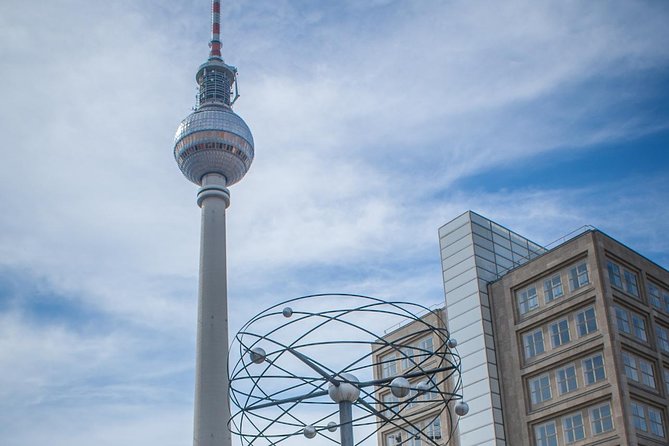
Next is Tiergarten, Berlin’s most famous inner-city park, with gardens and grand statuary. You get about 10 minutes here, which might sound short, but it works as a breather.
I like putting a park stop right before the Holocaust Memorial because it gives your brain a moment to reset. It’s not “time off.” It’s a shift in tone, from imperial and political geometry to an open space where your body can slow down.
Admission is listed as free. The only consideration is comfort: since the stop is short, bring yourself ready to stand and walk a bit. If you need frequent seating, you may want to plan a separate break later.
The Holocaust Memorial: walking a space built for reflection
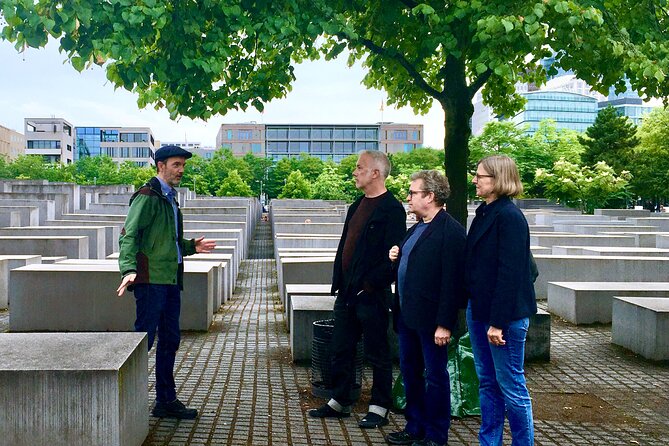
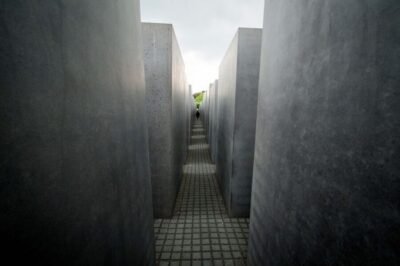
The day’s emotional centerpiece is the Memorial to the Murdered Jews of Europe. Designed by architect Peter Eisenman and opened in 2005, the memorial uses 2711 concrete slabs of different heights to create an enclosed, somber labyrinth-like experience.
You’ll be guided through what the space is trying to do: it’s meant for personal reflection. You enter the structure and experience it physically, not just intellectually. This is one of those times where the guide’s role is to keep you oriented and respectful, not to over-talk the space.
It’s about 10 minutes, and admission is listed as free. Ten minutes can feel like nothing once you’re inside. If you want a longer quiet moment, you might not get it during the scheduled stop, so consider whether you’ll return later on your own time.
Hackescher Markt: Art Nouveau courtyards and pre-war Berlin vibes
Finally, you reach Hackescher Markt, a lively square that shows preserved Art Nouveau courtyards of pre-war Berlin. This is a contrast stop. You’re shifting away from the heavyweight political and memorial themes into a part of the city that still carries a recognizable older texture.
The time is about 15 minutes, and admission is listed as free. I like ending here because it’s practical: after the walk, you’re near a cluster of places to grab food and keep exploring without needing a long commute.
One small note: since it’s a popular area, you’ll see plenty of movement around you. Use your last minutes to identify which courtyards you want to wander later, so you don’t feel lost the moment the tour ends.
Guide style, small group size, and the value of context
The tour is led by a historian for the three hours, and the guide team is described as people with academic and media backgrounds, including professors, doctoral students, journalists, and storytellers. That matters. You can feel it in how they connect architecture to ideas, and then turn those ideas into quick, understandable moments at each stop.
The small group cap, up to 8 people, is one of the biggest reasons this tour gets a perfect score. With fewer people, you’re more likely to get answers to your questions instead of watching the guide juggle timing. You’re also more likely to get attention when you’re curious about a facade detail or an odd historical reference.
I also appreciate that guides don’t leave you hanging. There’s an example of a guide named Dan who has taken people out of the route and sent them toward a lunch spot at an Italian restaurant. That’s a small touch, but it’s real help when you’ve just spent a few hours walking and learning.
Price and transit planning for a smooth day
The price is $156.53 per person for the about 3-hour tour. Is it cheap? No. But when you break it down, you’re paying for a historian and a route that hits multiple major sites in a short time span, including interpretive context that most people would struggle to assemble on their own.
It also includes a few value boosters:
- Group discounts
- Mobile ticket
- A historian-led format designed for learning on foot
Food and drinks are not included, so budget for a meal after the tour.
The big logistics item is transit. The tour notes that you’ll use public transport a few times, since walking distances between certain key sites would be too far in a single half-day. If you already have a multi-day Berlin transit pass, great. If not, the tour suggests buying a day metro pass.
Here are the fare details provided:
- One-way Tarif AB ticket: 2.8 Euro (senior discount 1.70 Euro)
- Day ticket (1 person): 7 Euro (senior discount 4.70 Euro)
If you can’t purchase the pass in advance, the guide will help you get it at the first metro station on the tour. That’s a practical safety net. Still, I recommend you check your plan the morning of so you’re not making decisions while you’re already in motion.
Who this tour fits best (and who might want a different format)
This tour is a strong match if you like:
- Architecture and political symbolism
- Walking routes that connect multiple eras
- A small group with room for questions
- Understanding how Germany’s modern story sits on older power structures
It’s also a good choice if you want to see the big Berlin landmarks without building a complicated self-guided itinerary across scattered neighborhoods.
If you hate using transit, or you want long museum interior time, you might be better with a different tour style. This one stays mostly on the street and in key viewing zones, with just enough time to orient you and set up later exploring.
Should you book this Berlin walking tour?
Yes, if you want a high-attention small-group history walk that ties major Berlin landmarks to the deeper forces that shaped the city. The Reichstag dome framing, the timeline through the Brandenburg Gate, and the respectful structure of the Holocaust Memorial stop are the kind of payoff you feel immediately. Add in the practical transit guidance, and it’s a strong value for a short visit.
Hold off if you’re the type who needs a lot of seating, long indoor time, or zero transit at all. For most people doing Berlin on a time budget, this is a smart way to get your head around the city quickly, and then enjoy it more on your own afterward.
FAQ
How long is the Berlin walking tour?
It runs about 3 hours.
What is the price per person?
The price is $156.53 per person.
Is the tour in English?
Yes, it is offered in English.
How many people are in the group?
The tour has a maximum of 8 travelers.
Where does the tour start?
The start point is Unter den Linden 42, 10117 Berlin, Germany.
Where does the tour end?
The tour ends in Berlin, Germany (with the destination listed as Berlin).
Is food included?
No, food and drinks are not included.
Is transportation included?
Transportation to and from attractions is not included. You will use public transport a few times during the tour.
Do I need a transit pass?
You may need a day metro pass if you do not already have one. The tour provides current fare amounts and notes that your guide can help you buy it at the first metro station if you cannot purchase in advance.
Is admission required for the main stops?
Admission tickets are listed as free at each named stop on the route.
Fresh reviews out of Berlin
- Gastro Tour with Klaus though the Wrangelkiez, Kreuzberg★ 5.0 · 9 reviews
- Wall Tour Berlin – Fates, Heroes & Love Stories★ 4.0 · 9 reviews
- Berlin City Tour with Hotel pick up and Drop off★ 4.0 · 9 reviews
- Berlin Private Street Art Tour – Off The Grid★ 5.0 · 9 reviews
- Romantic Berlin Rickshaw City and Photo Tour – incl. pick-up★ 4.0 · 9 reviews
- Quatsch Comedy Club Berlin: Quatsch Comedy Hot Shot★ 4.8 · 9 reviews
- Berlin Urbex Adventure and History Tour★ 5.0 · 9 reviews
- Stag Party Berlin: Celebration for Your Bachelor Party★ 3.4 · 9 reviews
Walking Tours, compared.

Berlin’s Best: 2 Hour Walking Tour Third Reich and the Cold War
Read our review →
Third Reich Berlin: Hitler and WWII Walking Tour
Read our review →Browse the lists this tour appears in