
Reviewed · WALKING TOURS
Walking Tour on Origins of Nazism in Munich – English
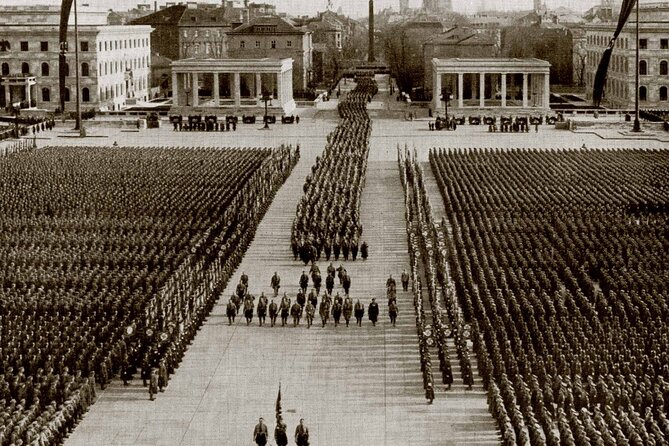
Nazism is one of the most difficult subjects in modern history, so it helps to study it in the exact places where it took shape. This English walking tour connects major turning points to Munich street corners and landmark spaces, so you get a clearer map of how a political movement gained traction in the early years.
I really like how the route mixes the famous with the grim, especially the stop at Staatliches Hofbräuhaus, where the party built its early base. I also like that the walk doesn’t only focus on propaganda and power, it includes a serious counterweight with places tied to victims and resistance.
One thing to keep in mind: 2 hours goes fast. The theme is heavy and wide, so you might crave more time, or want to pair this with a museum visit right after to follow the story further.
Key highlights to look forward to
- A focused 2-hour route with six major stops from Marienplatz area to Königsplatz
- Hofbräuhaus in context, not just as a classic beer hall, but as an early political base
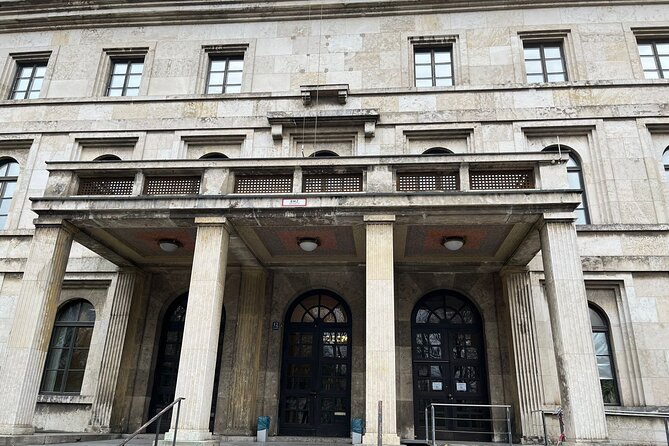
- Haus der Kunst and propaganda architecture, tied to the Third Reich’s messaging style
- Hofgarten as a breathing space, helping you reset before the next big idea
- Monuments for victims and resistance keep the human cost in view
- Mobile ticket and a max group size of 35 for smoother, less chaotic touring
Munich’s street-level story of how Nazism grew
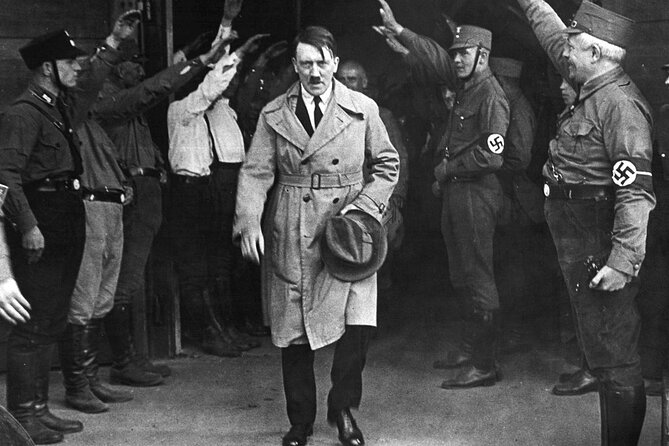
Munich is the place where a young Adolf Hitler was sent by the government with a mission to spy on the German Workers’ Party, and then somehow that effort turned into something much larger and much worse. Walking here matters because ideas did not float in the abstract. They were spoken, organized, performed, and promoted in real rooms and real public squares.
This tour is built around that cause-and-effect feeling. You are not just hearing a timeline. You’re moving through the city spaces that help explain how a movement could gain a foothold, then harden into something brutal. As you walk, you’ll also hear about episodes like Hitler’s coup attempt, the burning of Goebbels’ books, and the night of broken glass. The point is to connect those events to the atmosphere that surrounded them in the city.
More Walking Tours in Munich
- Munich: Third Reich & WWII Walking Tour
★ 4.6 · 6,181 reviews - Third Reich Walking Tour Munich
★ 4.5 · 4,291 reviews - Munich: Old Town & Viktualienmarkt City Walk in German
★ 4.7 · 2,304 reviews
Quick logistics: meeting point, timing, and what to expect
You start at Marienplatz in the central area, at Mariensäule, Marienplatz 22, 80331 München. The tour begins at 3:00 pm and runs about 2 hours. You end at Königsplatz 1, 80333 München, which is convenient if you plan to keep exploring after the walk.
The group size is capped at 35 travelers, so you should get a guided experience that stays conversational rather than purely lecture-style. You’ll use a mobile ticket, which is ideal in a city where transit and queues can eat time. The meeting area is also near public transportation, so it’s easy to plug into your day.
If you’re the type who likes to take photos while listening, you’ll be glad this isn’t an all-day slog. Just remember you’re covering a difficult topic, so keep your phone down at the moments where the guide is framing what happened and why.
Your 2-hour route: what each stop teaches you
The tour is paced as a sequence of short stops, each one designed to anchor a part of the story. Some locations include admission, and a few are free to visit at the stop level, so you’ll get a mix of outdoor space and entry points.
Here’s what you can expect, stop by stop.
1) Platz der Opfer des Nationalsozialismus: starting with victims
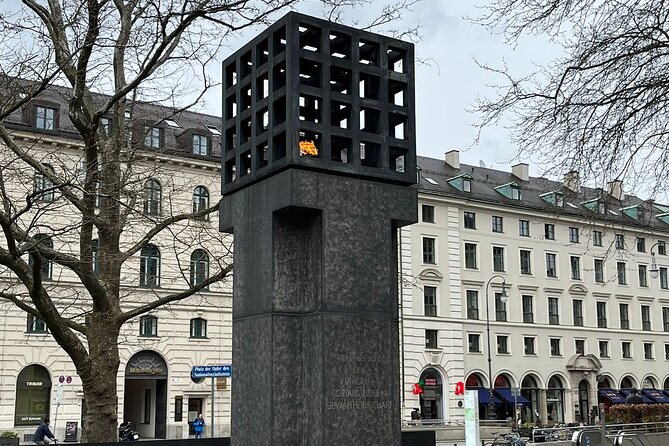
You begin at Platz der Opfer des Nationalsozialismus (Square of the Victims of National Socialism). This is a free stop of about 15 minutes.
Starting here changes how you experience the rest of the walk. You immediately face the consequences, not just the ideology. It also sets the tone for the guide’s larger point: Nazism was not an abstract “belief system,” it led to real people being targeted and harmed. If you’ve ever felt that history tours accidentally glamorize or romanticize the locations where power was staged, this opening stop helps prevent that.
Another way to spend a Munich afternoon:
- From Munich: Neuschwanstein & Linderhof Castle Full-Day Trip
★ 4.6 · 14,646 reviews - Neuschwanstein & Linderhof Castle-Fairytale Day Tour from Munich
★ 4.5 · 7,275 reviews - Dachau Concentration Camp Memorial Site Tour from Munich by Train
★ 4.5 · 5,637 reviews - Neuschwanstein Castle Tour from Munich
★ 4.5 · 5,117 reviews
2) Staatliches Hofbräuhaus: where politics met a famous beer hall
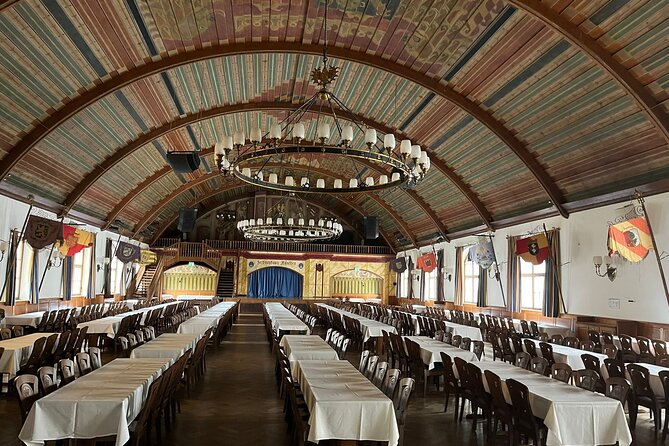
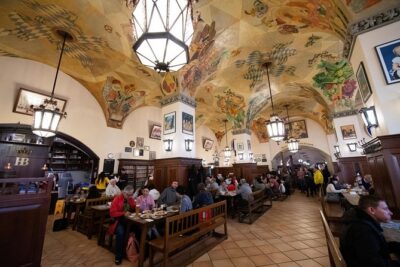
Next is Staatliches Hofbräuhaus, described as the mother of all breweries, and importantly, a place where the Nazi party established its base. This stop lasts about 15 minutes, with admission included.
Hofbräuhaus is the kind of place people know for atmosphere. But on this tour, the focus is not on the charm. You’ll connect the venue to how movements use everyday public spaces to look normal, social, and accessible. It’s a good lesson in how propaganda and organization can piggyback on places that already draw crowds.
A practical note: because it is a popular Munich site, it can feel lively even during a short visit. Wear comfortable shoes and be ready to listen through noise.
3) Haus der Kunst: a museum space shaped by the era’s messaging
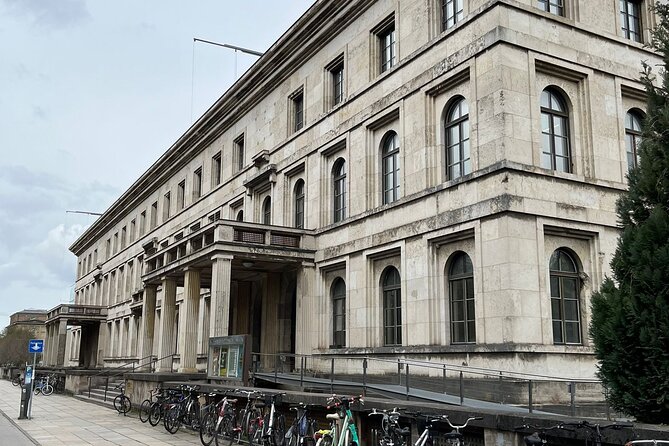
Then you move to Haus der Kunst, a current museum and also noted as the first propaganda building of the Third Reich. This is another 15-minute stop, with admission included.
This stop is especially valuable if you want to understand how the physical setting supports ideology. Propaganda is not only posters and speeches. It also includes architecture, presentation, and the feeling of significance people are encouraged to associate with the message.
If you’re hoping for a “this is exactly what happened here at this exact minute” kind of explanation, you may find the approach more interpretive. But that’s also where the value is. You’re learning how to read the environment like evidence.
4) Hofgarten: an important Munich park break
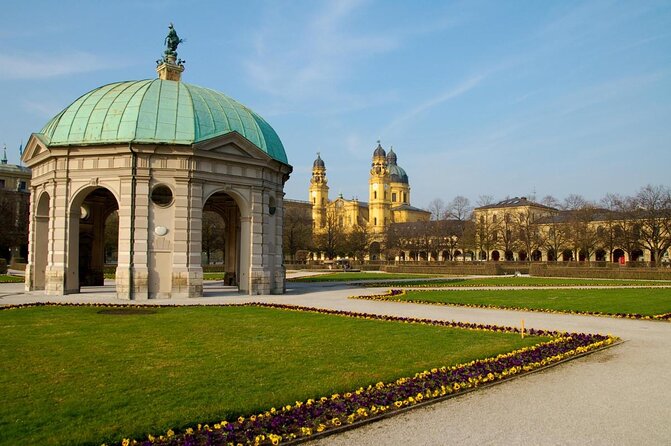
From there, the tour heads to Hofgarten, one of Munich’s important parks, for about 20 minutes. Admission is included.
This is a smart pacing choice. The tour is covering extremely dark subject matter, and a park stop gives you a mental reset. It also lets you look at the city’s grandeur and understand that authoritarian ideas rose in the middle of a place that many people experienced as beautiful, orderly, and powerful.
I like this kind of break because it keeps your attention sharp for what comes next. If you need to take a breath before the squares and monuments that lean more directly into power and spectacle, this is where you get it.
5) Odeonsplatz: a major square in Munich’s power geography
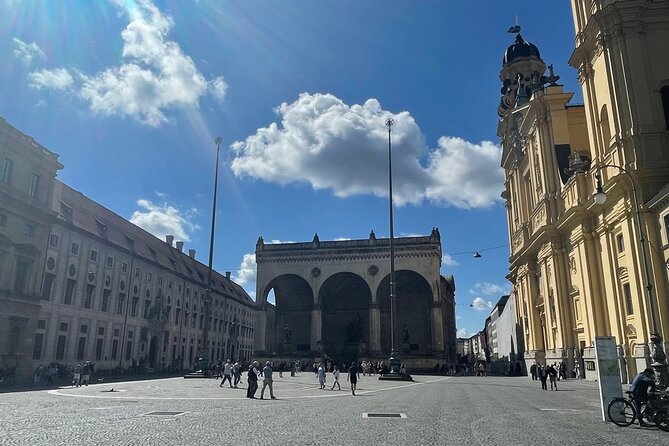
Next comes Odeonsplatz, one of the most important squares in Munich. This is a free stop around 15 minutes.
Squares are more than scenery. In political life, they’re stage sets. They gather people, concentrate attention, and make it easy to project authority. Odeonsplatz helps you see how public space can support mass movements.
It’s also a useful waypoint for orientation. Even if you aren’t a history buff, you’ll start to feel how the city is organized into visible “chapters.”
6) Königsplatz: the backbone of a redesigned city
The tour finishes at Konigsplatz, described as one of the main squares that formed the backbone of the new city designed by the Third Reich. This is a free stop of about 15 minutes.
This is a strong ending. It’s hard to ignore how a regime would want to reshape space to reshape perception. When you reach Königsplatz, the idea becomes physical: the city plan itself can communicate power, order, and belonging.
The tour ends at Königsplatz 1, which makes it easy to continue on foot afterward or link into transit to your next stop.
What makes this tour more than dates and slogans
The tour’s biggest value is that it treats history as a set of places you can study, not just a list of events. You learn how Nazism’s rise was connected to early political organization, how propaganda culture worked, and why cities can play a role in enabling ideology.
You’ll also get help untangling meaning and consequences. The tour is described as aiming to solve doubts about this complex, controversial subject. That is exactly what you want from a guided walk. It’s one thing to read about Nazism. It’s another to have a guide help you make sense of what you are seeing, especially when you encounter iconic Munich sites that can feel contradictory in light of the story.
And that balance is reinforced by the presence of places dedicated to the resistance and to victims of the war. That matters because otherwise a visitor might only notice the locations where power operated. Here, you’re also pushed to look at the costs and at those who opposed the regime.
Price and value: what you’re paying for at $20.16
At $20.16 per person, the price is positioned as a budget-friendly entry point. In a city like Munich, that’s not nothing, but it’s also not a museum-level price.
What helps the value is that you are paying for an expert guide and for included admissions at multiple stops. You’re not only doing a “look at the building” exterior walk. You’ll spend time at locations where admission is included, including Staatliches Hofbräuhaus and Haus der Kunst.
You’re also paying for structure. The itinerary runs about two hours with short stops, which makes it easier to fit into a day. If you’re visiting from out of town, that matters. If your goal is to get your bearings fast on the origins of Nazism in Munich, this format is a practical choice.
Who should book this, and who should plan differently
This tour is a great fit if you want a guided first pass through some of Munich’s most important sites tied to Nazism’s rise. It’s also a solid option if you prefer walking with interpretation over spending your whole day inside museums.
It may feel best for:
- People who like city landmarks and want clear orientation
- Visitors who have limited time but still want context
- Travelers who want both the political story and the memory of victims and resistance
You might want to plan something else, or add extra time, if:
- You want a deep, museum-length study of propaganda materials and detailed exhibits
- You know you’ll struggle to process the subject matter in a short window, because two hours can feel brisk
One detail to remember: this is a history walk in the city, and it is not a lunch plan. If you’re doing it at 3:00 pm, you’ll want to arrange food before or after.
Practical tips to make it a better experience
A few small choices can make a big difference on a tour like this.
First, come ready to listen. The guide will be connecting locations to heavy events like book burnings and violent episodes. If you keep bouncing your attention between photos, it becomes harder to absorb the point.
Second, wear comfy shoes. The stops are close enough for a walking tour, but the itinerary still moves through several key areas, and you’ll be on your feet.
Third, consider pairing this with one more layer after the walk. Because the route is short and the topic is wide, you’ll likely want to follow up with a museum visit or independent reading to get deeper on the themes you hear.
Should you book this Munich walking tour on Nazism’s origins?
If you want a clear, guided introduction to how Nazism took hold in Munich, I think this is a smart booking. You get expert context, a structured route through major sites, and a respectful balance that includes victims and resistance alongside the locations associated with propaganda and power.
I would skip it only if you already know the material well and need a longer, exhibit-based experience. In that case, you may want something more museum-focused. Otherwise, this is a strong way to start your understanding of Munich’s role in a violent 20th century story, using the city itself as your lesson plan.
FAQ
What is the duration of the walking tour?
The tour lasts about 2 hours.
Where does the tour start and end?
It starts at Mariensäule, Marienplatz 22, 80331 München and ends at Königsplatz 1, 80333 München.
What time does the tour begin?
The start time is 3:00 pm.
How much does the tour cost?
The price is $20.16 per person.
Is admission included at the stops?
Admission is included at some stops, including Staatliches Hofbräuhaus and Haus der Kunst, while other stops like the victims square and some squares are free at the stop level.
Does the tour include an expert guide?
Yes, an expert guide is included.
Is lunch included?
No, lunch is not included.
How big is the group?
The tour has a maximum of 35 travelers.
What is the cancellation policy?
You can cancel for free up to 24 hours before the experience starts for a full refund. Changes within 24 hours of the start time are not accepted.
Fresh reviews out of Munich
- Munich: Bulli Tour★ 5.0 · 9 reviews
- Neuschwanstein Castle Small-Group Guided Day Trip from Munich★ 5.0 · 9 reviews
- Private Day Trip from Munich to Eagle’s Nest and Hallstatt★ 4.5 · 9 reviews
- Munich: Highlights Walking Tour with a Guide★ 4.4 · 9 reviews
- From Munich: Private Guided Tour to Rothenburg ob der Tauber★ 5.0 · 9 reviews
- Private and full rickshaw tour in the English Garden★ 4.5 · 10 reviews
- Exploring Munich by Pedicab: Premium Two Hour Tour★ 5.0 · 10 reviews
- Segway Tour Munich Old Town 3 hours★ 4.5 · 10 reviews
Walking Tours, compared.
Berlin’s Best: 2 Hour Walking Tour Third Reich and the Cold War
Read our review →
Third Reich Berlin: Hitler and WWII Walking Tour
Read our review →Browse the lists this tour appears in