
Reviewed · HISTORICAL TOURS
Historic center of Berlin – Tour in Italian
Berlin can feel like a city built in chapters, not years. This 3.5-hour historic center walking tour in Italian strings the big turning points together as you move across the same streets people once used for escape, propaganda, and power.
I love that the guide keeps it clear and human, with commentary timed to what you can actually see. I also like the route choices, because you get both the famous icons and the darker places that explain why they exist. One thing to consider: it is mostly an outdoor walk, so you’ll want to dress for wind and cold.
Key highlights to know before you go
- Italian-speaking guide with practical, city-specific explanations along the way
- Small group size (maximum 28 travelers) that stays manageable on sidewalks
- WWII and Cold War landmarks in one connected route: Wall sites to the Brandenburg Gate
- Emotional memorial stops that put the meaning of Germany’s 20th-century past into context
- Easy museum follow-up since the tour ends near Pergamon Museum and Museum Island
- Start at Potsdamer Platz with a simple meet-up clue, the blue bicycle by Vive Berlin Tours
Starting at Potsdamer Platz, the point where modern Berlin learned to grow up
Potsdamer Platz is not just a landmark. It’s a reset button. In one place you can feel how Berlin rebuilt itself after destruction and political shock, then turned that history into something you can walk through today.
The tour begins at Potsdamer Platz 10, by the Vive Berlin Tours meeting point. The organizers make it easy to spot the group: look for the blue bicycle with the Vive Berlin Tours logo and flags. If you like fast, low-stress meet-ups, this setup helps.
You’ll start with a quick orientation and a sense of what comes next. Then the guide connects the dots between past and present, so stops like the Wall, the Cold War checkpoints, and the big government buildings do not feel like random photos. They feel like a storyline.
More Historical Tours in Berlin
- Berlin: Natural History Museum Entrance Ticket
★ 4.6 · 3,382 reviews - Berlin: 3-Hour World Heritage Cruise to Potsdam
★ 4.5 · 1,569 reviews - Berlin: History of the Third Reich Guided Walking Tour
★ 4.7 · 791 reviews
Sony Center and the smart way Berlin keeps old damage in the frame
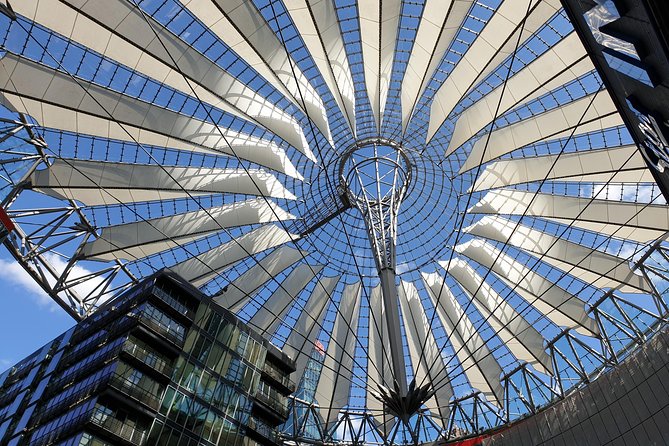
After you’re oriented, you head toward the Sony Center area. This stop works because it shows how Berlin handled wartime ruin without pretending the past didn’t happen.
What I like about this moment is the contrast. The space is contemporary and designed for crowds. But parts of what used to be there, including remnants from the destroyed area, are preserved and folded into the architecture. It’s the kind of detail that’s hard to notice if you’re moving fast on your own.
You’re not paying for an attraction here. You’re training your eyes. By the time you get to the more serious sites later, you’ll already be thinking about what was rebuilt, what was preserved, and what was replaced.
Topography of Terror, where the route turns from sights to meaning
This is the stop where the tone changes, in the best way. At Topography of Terror, you’re in a symbolic place that helps explain what Nazi dictatorship looked like on the ground.
The key point is location. The guide points to the area where the Gestapo and SS headquarters were located. That turns the history into something immediate, not abstract.
From here, you can also see nearby buildings that help complete the picture, including the former Nazi aviation ministry area and Martin Gropius Bau. And you’ll have an especially clear moment to notice an original segment of the Berlin Wall.
I find this stop valuable because it’s not just “here’s what happened.” It’s “here’s where it happened,” and that makes the later Cold War sites hit harder. You’ll understand why the Wall mattered not only as a barrier, but as a system.
Checkpoint Charlie, Cold War tension you can still read in the streets
Checkpoint Charlie is one of those places people recognize from movies, but the tour approach keeps it grounded. The guide explains why it was such a high-heat point during the Cold War, when Berlin became a stage for surveillance and political pressure.
Here you connect the Berlin Wall’s construction to the division of the city. You’ll walk away with a clearer idea of what “front line” meant inside a capital city, not just at a border crossing in the countryside.
One practical note: this part of Berlin can be busy. You’ll want comfortable shoes and patience. The tour keeps moving, but you’ll still feel the crowd energy because this is a top photo spot.
Another way to spend a Berlin afternoon:
- Berlin: Reichstag, Dome and Government District Guided Tour
★ 4.7 · 18,288 reviews - Berlin: 1-Hour City Tour by Boat with Guaranteed Seating
★ 4.3 · 16,993 reviews - Berlin: TV Tower Standard Entrance Ticket
★ 4.4 · 15,883 reviews - Berlin: Boat Tour Along the River Spree
★ 4.4 · 11,252 reviews
The Aviation Ministry building, from Nazi power offices to later government use
Next comes a building you might not have looked up on your own, which is exactly why walking tours can be worth it. The massive complex of the Aviation Ministry was built by the Nazi dictatorship to house the aviation ministry linked to Hermann Göring.
Then the story flips again in Berlin’s style. In the Cold War, it became part of the “home of the ministries” for the communist dictatorship. Today, it is used by the Federal Republic of Germany.
This is a good reminder that Berlin’s real theme is reuse. You’re seeing how regimes repurpose buildings, not just how they write laws. Watching that pattern while you walk gives you a deeper understanding than a single museum visit sometimes does.
Fuhrerbunker, a small stop with a huge emotional weight
The Fuhrerbunker site is brief in time but heavy in content. The guide explains where the bunker was and why Hitler spent his last days there, then connects it to the meaning of the place today.
I like that this stop is handled with care. You’re not rushing through an atrocity. You’re getting the essential context so it makes sense, including why there is a present-day explanation rather than silence.
If you prefer a tour that doesn’t treat dark history like a checkbox, this is where you’ll feel it. The group moves on, but you leave with a more grounded mental image of the end of the Nazi regime.
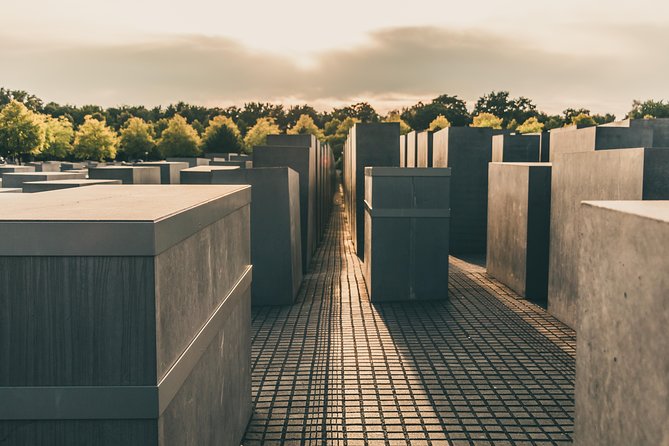
The Holocaust Memorial, a pause that changes how you see everything else
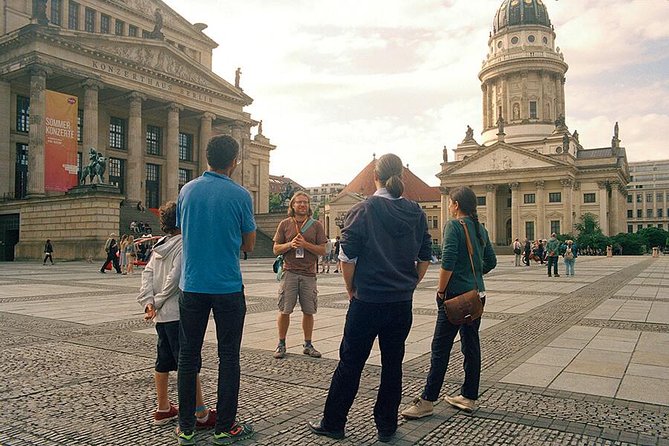
No matter how many times you’ve seen photos, the Memorial to the Murdered Jews of Europe lands differently in person. The guide shares stories that give shape to the emotion of the site.
This is the emotional anchor of the route. You’re not learning trivia. You’re absorbing the purpose of remembrance, and how Berlin carries the memory of the greatest crime committed by the German state in the Nazi period.
I suggest giving yourself a minute here without multitasking. Step back, look around, and let the space work on you. The tour format moves efficiently, but you can still slow down mentally for the memorial’s core message.
Reichstag outside view, and a useful tip for planning the dome visit
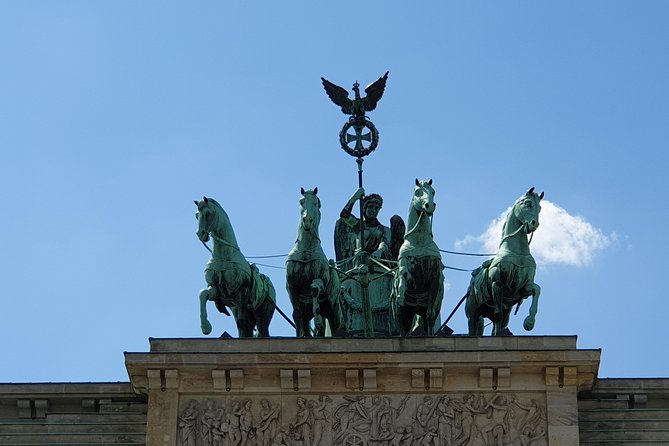
Then the tour steps into the politics of modern Germany. You reach the Reichstag Building, home of the German Parliament.
The tour’s focus here is outside viewing, but the guide gives guidance on how to book a visit to the dome. That matters because the Reichstag dome is one of those experiences people plan too late. If you’re starting at 10:00 am, you can often set yourself up well for later.
This stop is short, but it helps close the historical loop. You see the seat of today’s democracy, after walking through the locations tied to dictatorship and division.
Brandenburg Gate and Unter den Linden, reunification symbols with scars still visible
By the time you reach the Brandenburg Gate, you’re prepared to notice more than the obvious. Yes, it’s the most famous Berlin gateway, and yes, it’s heavily photographed. But the guide tells you how its symbolism changed.
From a king’s strength to a Cold War icon, it becomes one of the symbols of German reunification. That’s why it feels different if you’ve already walked through Wall-related locations. The story clicks.
Next comes Unter den Linden, the long avenue that once served as an access road to the emperor’s palace. Walking this stretch is a history lesson in layers. The guide helps you recognize different construction periods and also the wounds left by the war.
I like this pairing because it moves you from “monument” to “street.” When you see how the avenue evolved and what damage remained, you stop treating Berlin’s landmarks as isolated objects.
Bebelplatz, burning books, and the strange power of a memorial in a normal square
At Bebelplatz, the tour covers two things that might surprise you together. One is the square’s link to the burning of books during the Nazi dictatorship. The other is the square’s role as a university-facing center, tied to Humboldt University and nearby institutions like the Catholic Cathedral area.
The tour also includes the Book Burning Memorial at Bebelplatz, which exists to remember that propaganda act. Again, it’s short, but it’s the kind of stop that reframes Berlin’s intellectual life. It reminds you that censorship can be physical, not only ideological.
If you’re the type who loves learning why a place feels the way it does, this stop gives you that “oh, that’s why” moment.
Humboldt University and Neue Wache, learning Germany and remembering war’s aftermath
The tour continues with Humboldt University, where you learn about the university’s history and some of its famous students. Even with a short stop, it helps you understand why this part of Berlin matters beyond government buildings.
Then you reach Neue Wache, a memorial linked to the rejection of war and its horrors. The guide points to the imagery, a mother and a son, representing a soldier who fell in battle.
This part of the route is quieter. It shifts from political history to human cost and grief. That balance is important. Without the emotional memorials, the earlier Nazi and Cold War stops would feel like a timeline. With them, it feels like lived consequences.
Berliner Dom and Museum Island, a big finish that sets up your next day
The tour ends with a satisfying “big picture” closer. You pass Berliner Dom, the impressive cathedral built in the idea of an emperor who wanted a spiritual equivalent to St. Peter’s. The guide’s explanations make the scale and purpose easier to understand.
Then you wrap up at Museum Island, a UNESCO World Heritage Site. The tour finishes there and the guide shares directions for continuing your visit in a smart order.
Because the official endpoint is at Pergamon Museum, you get a natural next step. If you want to add major museum time after the walk, you’re already in the right neighborhood. And since the tour focuses on walking, this ending feels convenient rather than random.
What makes the Italian guides special, and why the small group matters
This tour’s biggest praised ingredient is the guide. You’ll hear multiple names in the guide roster, including Paolo, Giulia, Fabio, Chiara, Elena, and Daniele. The pattern in those examples is consistent: competent, organized storytelling in Italian, with guides who are attentive to the group.
That matters in Berlin because the city can be complicated, especially when you’re dealing with WWII and Cold War layers. A good guide does two things at once: they explain what you’re seeing, and they keep the route moving without rushing the meaning.
The tour size also helps. With a maximum of 28 travelers, you have enough people for energy but not so many that you spend the day stuck in traffic. It’s a real small group feel for a city-center walking route.
Price and value: how $27.91 fits a 3.5-hour history hit
At $27.91 per person, this is not the cheapest Berlin option. But it’s also not priced like a museum ticket plus extras. You’re paying mainly for a local guide plus local taxes, and for a guided route that stitches major sites into one coherent walk.
For a 3.5-hour experience, the value comes from two practical factors. First, you don’t have to plan a route across dozens of key places. Second, the Italian commentary helps you process what you’re seeing, not just collect photos.
What’s not included is also clear. You should plan for your own food and drinks, and you’ll handle any transportation to and from attractions. The tour format is built around walking and stopping, so it’s best if you’re comfortable covering a lot of ground on foot.
Who should book this Berlin walking tour in Italian
This tour is a great match if you want:
- A guided introduction to Berlin’s WWII and Cold War story
- An Italian-language guide rather than relying on your own translation work
- A walk that mixes the famous icons (like the Brandenburg Gate and Reichstag) with the more serious memorial context (like the Holocaust Memorial)
- A finish near Museum Island so you can plan museum time afterward
It may not be ideal if you hate emotional memorial sites or if you need lots of indoor time. The route is outdoors, and the tour operates in all weather conditions, so you’ll want layers and rain protection.
Should you book this Historic Center of Berlin tour?
If you’re trying to get your bearings fast and understand what you’re looking at, I think this is an easy yes. The combination of a trained Italian-speaking guide, a manageable group size, and a route that connects the Wall era to today’s Berlin makes it feel efficient without being cold.
Book it if your ideal day is walking, learning the why behind the big landmarks, and finishing near Museum Island so you can keep going. Skip it only if you want a more relaxed pace or you prefer to choose your own stops based strictly on personal interests, without a structured narrative guiding you.
If you’re on the fence, pick the time you can commit to. Starting at 10:00 am gives you enough day left to add museums, including the ones around the tour’s finish area.
Fresh reviews out of Berlin
- Berlin Uncensored: A History of Sex & Freedom★ 5.0 · 50 reviews
- Berlin Food & Cultural Tour: Must-Try German & Berliner Classics★ 5.0 · 51 reviews
- English Comedy Show with Pizza and Shots in Central Berlin★ 4.5 · 51 reviews
- Rude Bastards Tour of Berlin★ 4.8 · 51 reviews
- Private Taxi Tour of Berlin East and West and Neighbourhood approx. 4-6h★ 5.0 · 55 reviews
- Rickshaw Sightseeing City Tours Berlin – Rikscha Tours★ 4.0 · 55 reviews
- Berlin: City Highlights Express & Panorama Roof Terrace★ 4.9 · 55 reviews
- Berlin during Nazism – Tour in Italian★ 5.0 · 56 reviews
Historical Tours, compared.
City History Canal Sightseeing Tour on a Motorboat
Read our review →
Night Watchman Historic Adventure Tour
Read our review →
Browse the lists this tour appears in