
Reviewed · HISTORICAL TOURS
Where It All Began: Berlin’s Queer & Trans History Tour
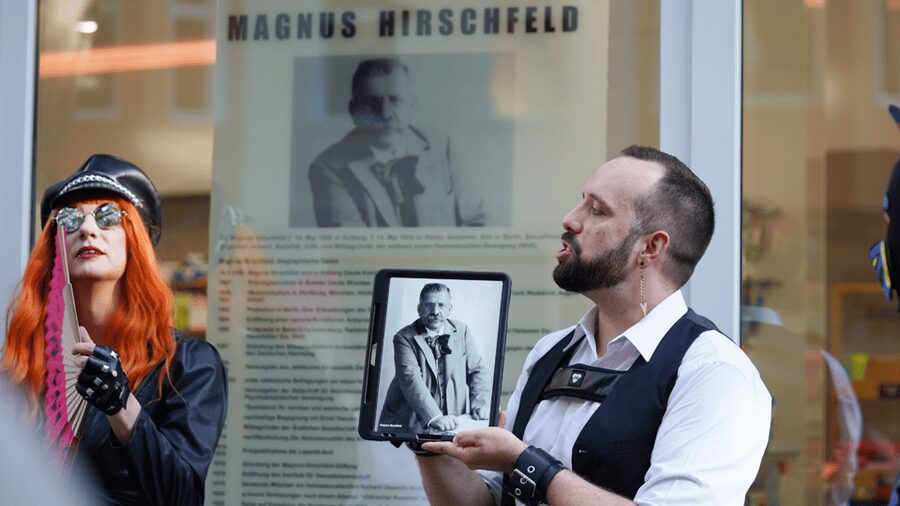
Berlin’s LGBTQ+ and trans history doesn’t show up in one tidy museum room. It’s built into street names, doorways, and the places where people risked everything to live out loud. I love that this tour keeps the group to just 10 people, so you actually hear the details. I also love the iPad augmented reality that overlays old photos right where they happened.
One thing to plan for: you cover a lot on foot in about 3 hours 30 minutes, and the tour depends on good weather, so wear shoes you trust and dress for the day.
Small-group cap of 10: more questions, less rushing, better focus
AR iPad + 200+ archival materials: photos and video show up in context
Led by a queer activist and gender scholar (Jeff): personal, serious, and well paced
Stops across eras: from early rights advocacy to today’s club scene and activism
Mixies AR photos: take home fun, personalized memories without extra effort
Free stop access: the key sites don’t require separate tickets during the walk
A 3.5-hour Berlin walk with iPad AR, capped at 10 people
This is a guided walking tour in Berlin focused on queer and trans history, starting at Else-Lasker-Schüler-Straße 18 and finishing at Metropol at Nollendorfpl. 5. The tour runs about 3 hours 30 minutes and is offered in English, with a start time of 2:00 pm. It’s priced at $83.13 per person, and for me the value comes from what’s included, not just the route.
Here’s what you’re paying for: a guided, thematic walk, plus the tools that make history feel grounded in the street instead of floating in facts. The tour includes an iPad for augmented reality elements, Mixies for personalized AR photos, and access to 200+ rare historical photos, videos, and archival materials you can use to remember what you saw. That’s a lot of content for a half-day stroll.
If you’re the type who likes to look around and figure things out on your own, this won’t replace that. It gives you a structure and story line so you don’t miss the key names and turning points.
AR on an iPad and Mixies photos: how the past shows up where you stand
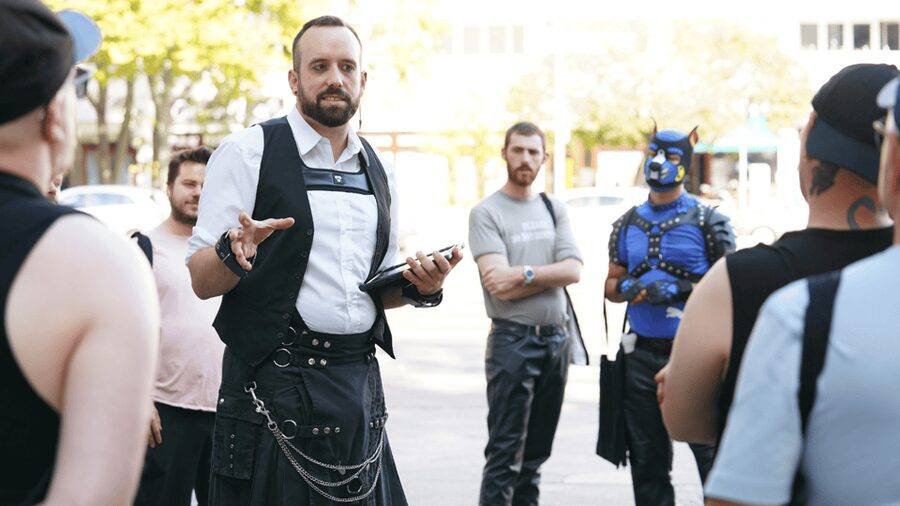
The “wow” factor here is the augmented reality built into the experience. You get an iPad to use during the walk, and the AR elements help place historical images in the exact location you’re standing in now. It’s one of those rare tourism add-ons that actually helps your brain do the timeline math, instead of just adding screen time.
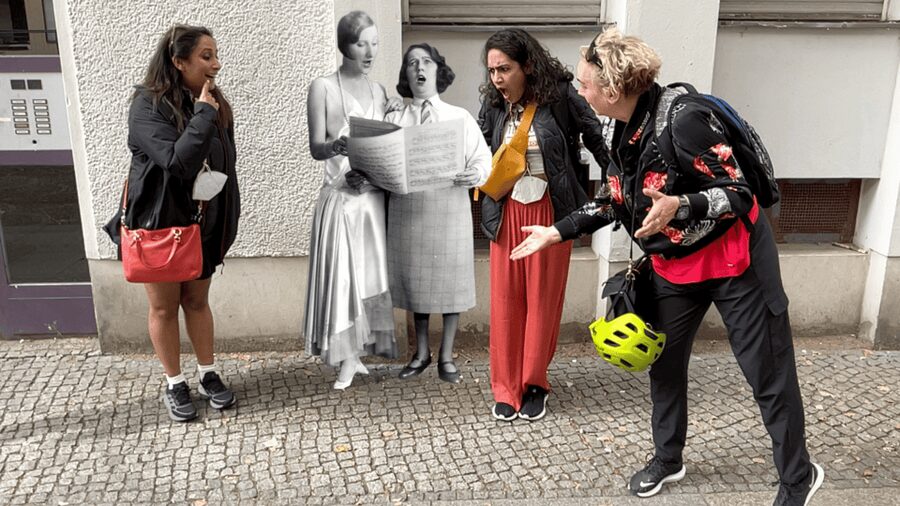
On top of that, you’ll use Mixies to take fun, personalized photos with AR elements. In practice, it means you can take something playful home while the guide keeps the tone human and respectful. The result is both memorable and useful, because the photos aren’t just pretty. They’re tied to what you learned at each stop.
One more practical detail: the tour includes a mobile ticket, which keeps things simple on the day. You still need to show up at the correct meeting point, but you won’t be juggling a pile of paper tickets.
More Historical Tours in Berlin
- Berlin: Natural History Museum Entrance Ticket
★ 4.6 · 3,382 reviews - Berlin: 3-Hour World Heritage Cruise to Potsdam
★ 4.5 · 1,569 reviews - Berlin: History of the Third Reich Guided Walking Tour
★ 4.7 · 791 reviews
Stop 1: Karl-Heinrich-Ulrichs-Straße 1, the early gay rights advocate
You start the tour at Karl-Heinrich-Ulrichs-Straße 1, named for Karl Heinrich Ulrichs. He’s often described as an early public advocate for decriminalizing homosexuality, long before the modern terms for sexual orientation were widely used. The point of this stop is not to treat him like a statue. It’s to understand that queer rights organizing didn’t begin in the 1960s or with a single movement. It started earlier, with people pushing back at the legal and social systems around them.
If you like origin stories, this is a strong opener. It gives you a baseline for how ideas about queer identities formed over time, and it sets up the rest of the walk, where you’ll see those ideas attacked, distorted, and fought over.
Stop 2 at Nollendorfplatz: persecution in Nazi Germany and the pink triangle
Next comes Nollendorfplatz, often described as a core location in Berlin’s LGBTQIA+ history. This is where the tour turns from advocacy into threat. You’ll hear about Adolf Brand and right-wing gay activists, plus the complicated and painful role of Ernst Röhm. The guide also covers how Hitler’s stance on homosexuality fed mass persecution.
A key part of the stop is the Night of the Long Knives, when Röhm and other queer people inside the Nazi party were executed. The stop also connects that violence to what happened later in camps, including forced identification with the pink triangle.
This is an emotionally heavy segment. The practical value is that you learn how persecution worked on multiple levels: propaganda, internal political purges, and dehumanizing camp policies. You also see how the people involved in Nazi institutions were not a single-note villain story. The reality is uglier, because it involved self-serving hypocrisy inside the regime.
Stop 3 at Schwerinstraße 13: lesbian life, Toppkeller, and resistance through culture
At Schwerinstraße 13, the tour shifts to lesbian life in 1920s Berlin, a side of history that’s often overlooked when people rush through German stories. The guide focuses on Toppkeller, a famous lesbian bar site, and explains how spaces like that provided community and safety for queer women. That matters because legal rights and everyday life do not move together at the same pace.
You’ll also hear about Claire Waldoff, a lesbian cabaret singer whose songs became anthems of defiance. Cabaret might sound like pure entertainment, but here it’s political language. Then you get Josephine Baker, a bisexual performer who became a sex symbol across genders.
What I like about this stop is the balance. It doesn’t only focus on danger. It shows what people built when conditions were better, and how culture carried meaning.
Another way to spend a Berlin afternoon:
- Berlin: Reichstag, Dome and Government District Guided Tour
★ 4.7 · 18,288 reviews - Berlin: 1-Hour City Tour by Boat with Guaranteed Seating
★ 4.3 · 16,993 reviews - Berlin: TV Tower Standard Entrance Ticket
★ 4.4 · 15,883 reviews - Berlin: Boat Tour Along the River Spree
★ 4.4 · 11,252 reviews
Stop 4 at Nollendorfstraße 17: Christopher Isherwood and the queer angles of Berlin police work
At Nollendorfstraße 17, the tour makes an unexpected move. You’ll explore the homosexual department of the Berlin police force, which is a reminder that the state’s attention could be both invasive and strangely specific. This stop uses that shock value for a reason: it helps you understand how queer people were tracked, categorized, and controlled.
The guide also covers gay male life in 1920s Berlin, with a focus on Christopher Isherwood. His writings about Berlin helped inspire the famous Cabaret musical and film. You’ll also learn about his relationship with Heinz Neddermeyer and their escape from Nazi Germany as queer refugees.
This stop is good if you like cultural history, but you don’t get only art trivia. You get how personal stories and official power intersected, and why queer memoir and reporting mattered for later generations.
Stop 5 at Magnus-Apotheke: Magnus Hirschfeld, the Institute for Sexual Science, and Paragraph 175
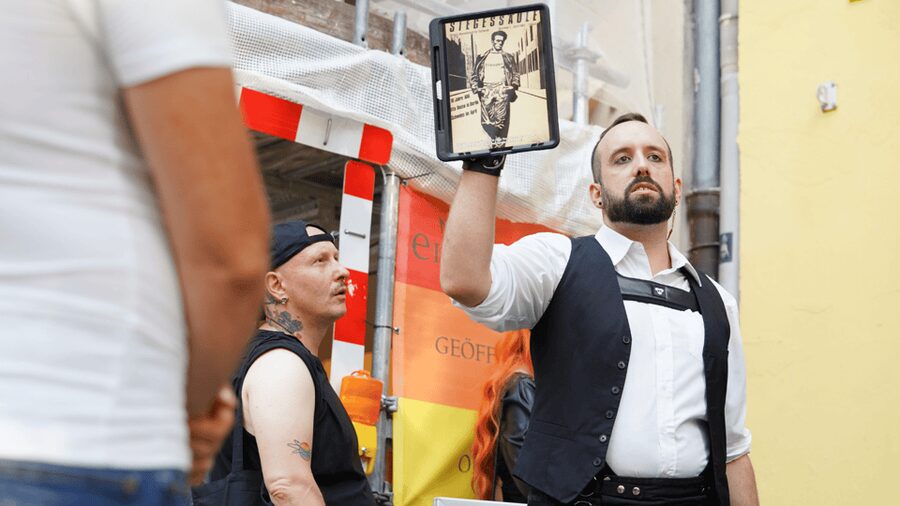
One of the most important stops is at Magnus-Apotheke, tied to Magnus Hirschfeld and his activism. The tour connects you to the Institute for Sexual Science and the Scientific-Humanitarian Committee, which the guide describes as the world’s first organization dedicated to queer rights and gender studies.
You’ll also hear Hirschfeld’s theories, including ideas about “sexual intermediaries” and the concept of Berlin’s third gender. The stop then becomes concrete and specific with mentions of world-leading medical work associated with gender-affirming surgeries performed on people like Dora Richter, Lili Elbe, and Karl M. Baer.
Then comes a crucial legal section: the fight against Paragraph 175, which criminalized homosexuality. The tour ends the stop on a devastating note, explaining how the Institute was destroyed by the Nazis.
This is where you feel the tour’s core strength. The guide doesn’t treat rights history like a timeline of famous names only. It shows how science, law, culture, and activism collided, and how quickly progress could be erased.
Stop 6 at Denns BioMarkt: Eldorado drag bar and the scary paradox of Ernst Röhm
At Denns BioMarkt, you hit the site connected to Eldorado, one of Berlin’s most famous drag bars of the 1920s. The stop is about performance as survival, and about the real-world community that formed around people who didn’t fit gender norms.
The guide also adds a twist that makes the history feel painfully complicated. Eldorado was frequented by gender-nonconforming people and queer performers, yet it’s also linked to high-profile Nazi figures, including Ernst Röhm. The tour doesn’t ask you to romanticize that contradiction. It uses it to show how regimes could tolerate something socially in one moment while planning to crush it later.
If you’ve ever wondered how persecution can follow close after visibility, this stop helps explain the mechanism. Visibility is not safety, and it’s not protection from politics.
Stop 7 at Prinz Eisenherz: post-war activism, SchwuZ, and Charlotte von Mahlsdorf
After the Nazi era, you move into post-war organizing. The stop at Prinz Eisenherz covers groups and spaces that helped rebuild queer life after WWII, including Homosexuelle Aktion West-Berlin. You also hear about SchwuZ, one of Berlin’s iconic queer clubs.
Then the tour spotlights Charlotte von Mahlsdorf, a trans woman who preserved Berlin’s queer history and created safe spaces for the community in East Berlin. That last detail is important. History isn’t just written. It’s saved, protected, and passed on through people who refuse to let it vanish.
This stop gives the walk a forward rhythm. It’s not a “look how bad things were” ending. It’s a “how people kept going” beat, with names you can later look up without starting from zero.
Stop 8 at the Connection stop: Chez Romy Haag and trans-led nightlife in West Berlin
At the Connection stop, the focus moves to trans community life in West Berlin during the 1970s and 1980s. You’ll hear about Chez Romy Haag, described as a legendary trans-led nightclub that changed Berlin nightlife. The guide frames it as a place where gender-diverse people could exist openly.
This is one of those tour moments that feels like it belongs in the present. You’re learning how today’s queer club culture has roots, and how nightlife has often served as the community center when other institutions fail people.
The practical takeaway is simple: Berlin’s queer spaces were not accidental. They were built, defended, and shaped by trans people and allies willing to make room.
Stop 9 at Internationale Stele GEGEN DAS VERGESSEN: the AIDS crisis and the divided city
Stop 9 turns the emotional temperature up again, covering the AIDS crisis in Berlin and how it hit a city split between East and West. You’ll see how the queer community organized for survival and you’ll learn about activism linked to Rita Süssmuth, including her advocacy for AIDS awareness.
The guide also uses a striking phrase tied to politics and division, describing the Berlin Wall as a metaphorical condom of the GDR. The point is not the metaphor itself. The point is that East and West Berlin handled the crisis differently, and those differences mattered.
This stop is where the tour becomes more than street names. It’s about public health, misinformation, activism, and the cost of neglect.
Stop 10 at Metropol: Pride, fetish culture, and fighting gentrification in today’s Berlin
The final stop at Metropol brings you into contemporary queer nightlife and activism. You’ll learn about Metropol’s role in early gay community and techno scenes, plus how it connects to Berghain and Lab.Oratory.
You’ll also hear about SO36 and legendary queer nights, and about major events like Folsom Europe (called Europe’s biggest fetish festival), Kreuzberg Pride, and the Dyke March. The tour ends with political pressure on the city itself, including the ongoing fight for an affordable Berlin led by the radical Tuntenhaus squat.
This ending works because it doesn’t treat today as separate from the past. It ties queer community life to real-world fights over space, rents, and whether queer culture can survive neighborhood change.
Start-to-finish logistics that actually matter on the day
You meet at Alnatura Super Natur Markt, Else-Lasker-Schüler-Straße 18, 10783 Berlin, and the walk ends at Metropol, Nollendorfpl. 5, 10777 Berlin. It starts at 2:00 pm.
The route is a walking tour, and the tour notes that it depends on good weather. If you’re someone who hates being outside too long, you’ll still probably be okay, since the total time is about 3.5 hours. Just plan for real walking.
Language is English and the group is capped at 10 people, so you should expect a more conversational pacing than big-city bus tours. Service animals are allowed, and most travelers can participate, which helps if you’re traveling with a companion or need calm, direct support.
One more practical detail: admission tickets are listed as free at the stops. That means you are mostly paying for the guide, the AR, and the content, not for a museum fee stack.
Who should book this tour, and who might want something else
Book this if you want a clear timeline of queer and trans history across Berlin, and you like learning through real places rather than only through a brochure. This tour is especially good if you’re into culture, politics, and the way nightlife connects to rights movements.
You’ll also enjoy it more if you like guides who can handle both humor and heaviness in the same walk. The guidance style here is engaging and story-driven, with enough moving parts that you don’t feel like you’re reading a textbook on sidewalks.
If you want a purely relaxed, social stroll with zero hard topics, you might find parts of the tour intense, especially when Nazi persecution and the AIDS crisis come up. This is not a comfort tour. It’s a meaning-focused one.
Should you book Where It All Began in Berlin?
I think you should book if you want a tour that treats Berlin’s queer and trans story like it belongs in the streets, not just in theory. The combination of small group size, AR iPad elements, and the sheer amount of archival material is a strong value play for the price. You’re not just walking, you’re assembling context as you go.
It’s also a smart choice if you hate generic tours that skip the names. You’ll walk away with specific people and places to follow up on, from Karl Heinrich Ulrichs and Magnus Hirschfeld to Charlotte von Mahlsdorf and Rita Süssmuth, plus key nightlife touchpoints like SchwuZ and Chez Romy Haag.
If you’re traveling on a tight schedule, this half-day format is workable. Just respect the weather note, wear good shoes, and give yourself a little time afterward to process what you saw.
FAQ
How long is the Berlin queer and trans history tour?
It lasts about 3 hours 30 minutes.
How much does the tour cost?
The price is $83.13 per person.
What language is the tour offered in?
The tour is offered in English.
How big is the group?
The tour has a maximum of 10 travelers.
What is included in the price?
Included items are a guided walking tour led by a queer activist and gender scholar, iPad augmented reality elements, Mixies personalized AR photos, 200+ rare historical photos and archival materials, and insider tips on modern queer nightlife and events.
Is coffee or tea included?
No. Coffee or tea, if there is a café stop, is not included.
Where does the tour start and end?
It starts at Alnatura Super Natur Markt on Else-Lasker-Schüler-Straße 18 (10783 Berlin) and ends at Metropol on Nollendorfpl. 5 (10777 Berlin).
Is the meeting point near public transportation?
Yes, it is near public transportation.
Does the tour run in any weather?
The tour requires good weather. If it is canceled due to poor weather, you’ll be offered a different date or a full refund.
What is the cancellation policy?
You can cancel for free up to 24 hours in advance for a full refund. If you cancel less than 24 hours before the start time, the amount paid is not refunded.
Fresh reviews out of Berlin
- Gastro Tour with Klaus though the Wrangelkiez, Kreuzberg★ 5.0 · 9 reviews
- Wall Tour Berlin – Fates, Heroes & Love Stories★ 4.0 · 9 reviews
- Berlin City Tour with Hotel pick up and Drop off★ 4.0 · 9 reviews
- Berlin Private Street Art Tour – Off The Grid★ 5.0 · 9 reviews
- Romantic Berlin Rickshaw City and Photo Tour – incl. pick-up★ 4.0 · 9 reviews
- Quatsch Comedy Club Berlin: Quatsch Comedy Hot Shot★ 4.8 · 9 reviews
- Berlin Urbex Adventure and History Tour★ 5.0 · 9 reviews
- Stag Party Berlin: Celebration for Your Bachelor Party★ 3.4 · 9 reviews
Historical Tours, compared.
City History Canal Sightseeing Tour on a Motorboat
Read our review →
Night Watchman Historic Adventure Tour
Read our review →
Browse the lists this tour appears in