
Reviewed · CRUISES & BOAT TOURS
Berlin East Side Tour 2.5 hour cruise with commentary
Berlin’s big sights are fun on foot, but they can feel chopped up. This 2.5-hour East Side Spree cruise strings landmarks together in a logical order, and you get a moving viewpoint that makes the city feel readable. You are also physically part of Berlin’s water story, not just looking at it from a sidewalk.
What I like most is the mix of Berlin Wall memory and everyday city life, especially around the East Side Gallery and the bridges nearby. I also like the way the boat slows down for the Mühlendammschleuse lock, which turns a normally quick commute segment into a real moment to understand how Berlin worked on the water.
One consideration: audio and comfort depend on where you sit. The top deck usually has better views, but it can be harder to hear, and some seating setups get hot indoors on warm days.
Key Things Worth Knowing Before You Board
- Longer than the common 1-hour cruises, so you see more stretch of the Spree without feeling rushed
- Mühlendammschleuse lock stop gives you a rare chance to watch Berlin’s waterways in action
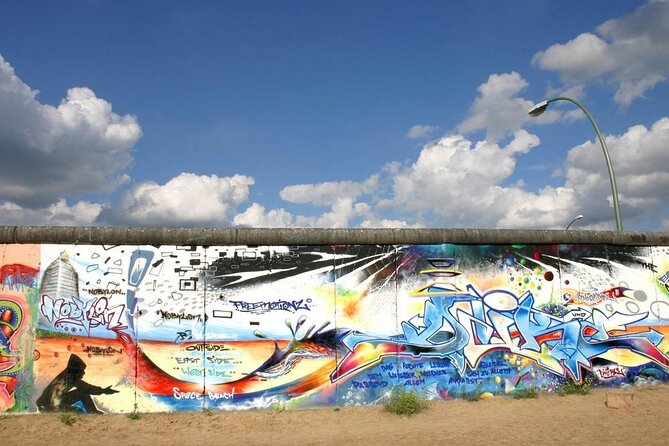
- East Side Gallery in an outdoor, wall-length setting, plus the surrounding bridge area you would miss on foot
- Live commentary in both German and English, so pick a good spot to catch the English part
- Top-deck views beat window-bound sightseeing, especially for the Reichstag and Museum Island area
- Small-boat feel with a max group size of 55, which helps the ride stay relaxed
Why This 2.5-Hour Spree Cruise Makes Berlin Easier to Read
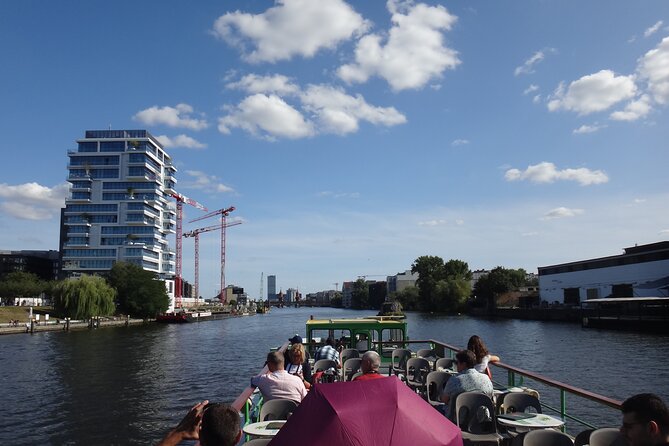
This is the kind of tour that helps you get your bearings fast. Berlin can be confusing on day one because the city is split into neighborhoods, political eras, and rebuilding phases. From the water, those pieces line up in a way that feels natural.
I like that the itinerary doesn’t stay stuck in one theme. You shift from architecture and museums to boundary history, then back to present-day public spaces. The whole thing feels like a guided walk along the Spree, except you are sheltered and moving.
The boat ride itself also sets the pace. It tends to feel more like a slow afternoon than a sprint through photo stops, which helps if you want to actually look at details rather than just capture them.
More Boat Trips in Berlin
- Berlin: 1-Hour City Tour by Boat with Guaranteed Seating
★ 4.3 · 16,993 reviews - Berlin: Boat Tour Along the River Spree
★ 4.4 · 11,252 reviews - Berlin: 1-Hour Boat Tour with Bilingual Guide (Ger/Eng)
★ 4.7 · 4,800 reviews
Price and Value: Why $36.04 Can Be a Good Deal Here
At $36.04 per person for roughly 2 hours 30 minutes, the value comes from what is bundled: a boat trip plus live commentary in English and German. You are paying for context, not just transit.
This tour is also priced like a mid-length sightseeing experience, and the length matters. A 1-hour version often covers the same “main hits” but turns the most interesting segments into brief flashes. Here, you get time for the lock and enough time to see a longer corridor of the city, including major government-area buildings.
One more value point: the cruise format gives you a different angle on places you can easily visit on foot later. Seeing the Reichstag area, bridges, and Museum Island from the water is not a replacement for visiting those sites, but it makes your later visits smarter because you understand where things sit.
Food and drinks are not included, and you do buy them onboard if you want. That said, the boat does have an onboard bar, so you can plan to grab a coffee or beer while you watch Berlin roll by.
Meeting Point and Timing: What Your 2:45 pm Start Means
You meet at Anlegestelle Alte Börse / BWSG Berliner Wassersport und Service GmbH, Burgstraße 27, 10178 Berlin. The tour starts at 2:45 pm and returns you to the same meeting point.
That late-afternoon timing is helpful because you can often get nicer light for photos and a more relaxed crowd. It is also a practical window if you want to do this on day one or day two, then switch to walking visits afterward with better orientation.
The tour is confirmed at booking and you get a mobile ticket. If you plan to check in early, you will usually feel more comfortable getting settled before boarding ramps up.
Choosing Your Seat: Top Deck Views vs. Comfort and Sound
The boat includes a toilet onboard and an onboard bar with food and drinks available for your own expense. Most people can participate, and the boat is set up for sightseeing rather than long-haul comfort.
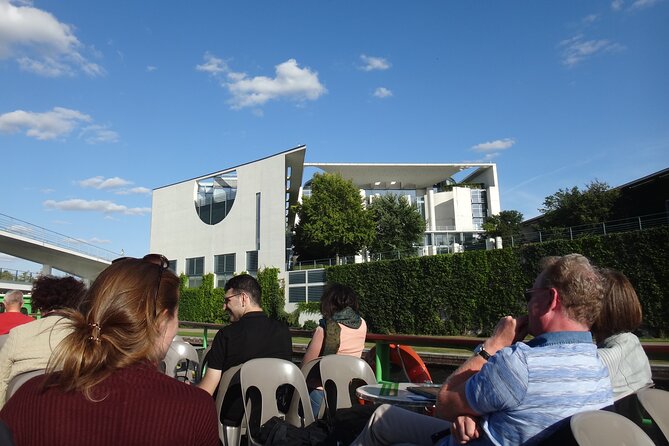
Here is the tradeoff you should plan for. The top deck gives better sightlines, and you will usually want it for panoramic views and skyline moments. The downside is that some people find it harder to hear the commentary up top, especially when the crowd is chatting or the wind is strong.
Inside, you might hear more clearly because the audio is closer, but seating can feel tight and it can run hot if the weather is warm. If you get sensitive to heat, consider coming with a light layer and plan to move if you need air.
A simple tip: if you care most about the English part, sit where you can follow the guide without leaning or straining. Some parts of the ride include long stretches between major landmarks, and you will want those moments to be usable, not just “waiting for the next point.”
Another way to spend a Berlin afternoon:
- Berlin: Reichstag, Dome and Government District Guided Tour
★ 4.7 · 18,288 reviews - Berlin: TV Tower Standard Entrance Ticket
★ 4.4 · 15,883 reviews - Discover Berlin Half-Day Walking Tour
★ 5.0 · 9,624 reviews - Berlin: Government District around the Reichstag Guided Tour
★ 4.7 · 8,447 reviews
Lustgarten, Berlin Cathedral, and Humboldt Forum: Culture First, Then History
Early on, you pass the Berlin Cathedral at Lustgarten on Museum Island. This Protestant church, officially known as Oberpfarr- und Domkirche zu Berlin, was built between 1894 and 1905 in Neo-Renaissance and Neo-Baroque styles. It also functions as a key dynastic burial site, which adds meaning to what you see from the water.
A bit later, you glide by the Humboldt Forum in the Berlin Palace complex. It is a universal museum that houses collections from the Berlin State Museums, including ethnology and art from Asia. It also hosts city-focused exhibitions and includes the Humboldt Laboratory from Humboldt University.
This segment works well because it sets the “Berlin is layered” theme immediately. You are seeing buildings tied to state power, museum culture, and public life, all along one river corridor. It is a gentle lead-in before the tour turns to boundary history.
Mühlendammschleuse Lock: The One Stop You Will Remember
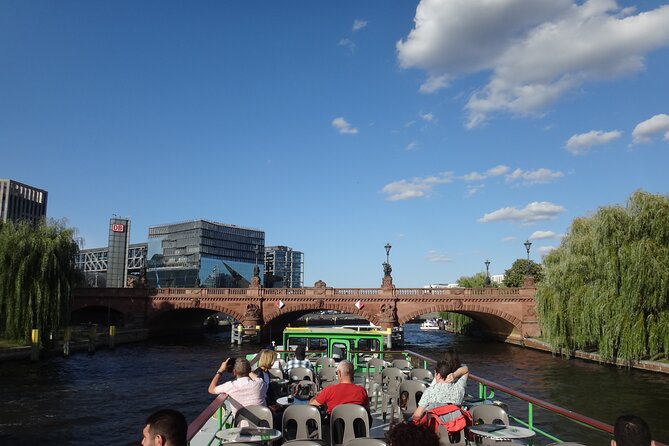
One highlight is the stop at Mühlendammschleuse, located in Mitte, east of Mühlendamm on the Fischerinsel. This is where the Spree-Oder waterway matters locally, and where Berlin’s early geography connects to the city’s origin story.
The lock is also practical to watch. You get around 20 minutes here, and it overcomes a drop of 1.51 meters. The lock went into operation in 1942, so it is tied to modern infrastructure rather than just old legends.
This is the kind of stop that makes a river cruise worth the money. On foot, you pass places and keep moving. Here, you slow down on purpose, so you can actually understand what the river is doing and why Berlin built for water traffic.
East Side Gallery: Berlin Wall Memory in Motion
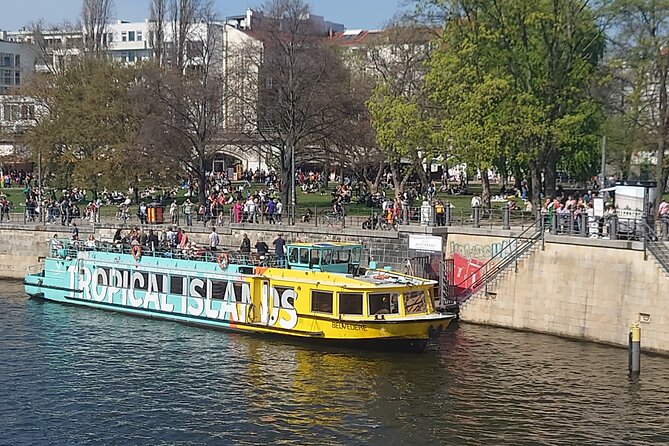
Then comes the emotional center of the ride: the East Side Gallery. It is an open-air memorial on the longest surviving section of the Berlin Wall along Mühlenstraße by the Spree, running between Ostbahnhof and Oberbaum Bridge.
After the Wall opened in 1990, 118 artists from 21 countries painted this stretch in spring 1990, across about 1,316 meters. The idea was to comment on the political changes of 1989 and 1990 through roughly a hundred paintings, on the side that faced East Berlin at the time.
One detail that adds depth: today you are not seeing every original panel. Urban planning changes meant only replicas from 2009 remain where parts used to be.
What you gain from seeing it by boat is scale. You feel the Wall as a long barrier in real space, not just as a photo you can scroll past. The river position also helps you understand the layout of the former border area, where the Hinterland Wall cut off the border zone from East Berlin.
Oberbaum Bridge and the Customs Waterway Story
As you continue along the Spree, you move through the area of the Oberbaum Bridge. This is one of Berlin’s best-known crossings, and the cruise angle makes the bridge feel like part of the city’s spine rather than a random landmark.
You also get historical context tied to the river itself. The route explains that earlier wooden bridge setups controlled passage and allowed Berlin to collect customs duties. At night, a thick trunk reinforced with iron nails, known as the tree, closed the passage. There was also an upper counterpart, and later, around 1723, a new wooden bridge was built with flaps for shipping traffic by royal order, tied to the Stralauer Tor entrance to Berlin.
Even if you do not love dry history, this segment helps you connect modern bridges to older control points. You start to see why Berlin’s center grew where it did, and why the Spree mattered for trade, movement, and control.
Molecule Man: Contemporary Art in the Middle of the River
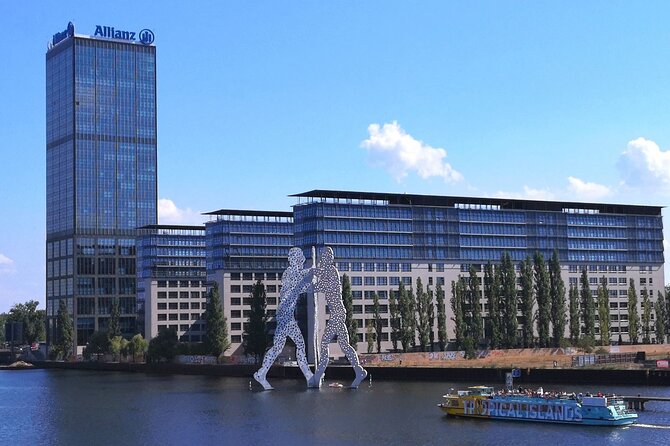
Along the same corridor, you pass Molecule Man, the monumental sculpture by Jonathan Borofsky from May 1999. It is a three-person sculpture installed in the Spree between Elsenbrücke and Oberbaumbrücke, near the meeting point of Kreuzberg, Alt-Treptow, and Friedrichshain.
This is a great “breather” after heavier Wall history. It reminds you Berlin is not only about what happened here, it is also about what artists and the city build now, right in the middle of everyday space.
If you like public art, you will appreciate the moment because you can view it from a moving platform, which changes how you read size and form.
Nikolaiviertel and Museum Island Area Sights: Old Berlin Rebuilt
The tour also passes Nikolaiviertel in Mitte, described as the oldest settlement area in the capital. World War II destroyed most of it, and it was rebuilt from 1980 to 1987 by architect Günter Stahn for the East Berlin magistrate for Berlin’s 750th anniversary.
Around the reconstructed Nikolaikirche, you get an ensemble of historic town houses and prefabricated buildings adapted to an almost medieval floor plan. From the boat, you do not get the walking pace to inspect every façade, but you get the feeling of place and boundaries.
Then you are still in the Museum Island universe. The ensemble includes multiple museums and is on UNESCO World Heritage listing as a whole. The James Simon Gallery opened as a visitor center in 2019, adding a modern entry point to a historic museum cluster.
As you glide past, it helps to remember: Museum Island is not one building. It is a whole museum complex shaped by Prussian kings between 1830 and 1930, later renovated and expanded after reunification.
TV Tower and Schiffbauerdamm: Pop Landmarks Meet River Life
You also pass the Berlin television tower, the tallest building in Germany at 368 meters. When it opened in 1969, it was second highest in the world, and it still draws about a million visitors a year. From the Spree corridor, it becomes a clear vertical marker, easy to spot even if you are busy looking at bridges and rooftops.
Nearby, you pass the Schiffbauerdamm, the street on the right bank of the Spree in Mitte. The name points to shipbuilding companies that used to be there, which fits the broader theme: this river shaped work and industry, not just sightseeing.
You also may notice lively river-adjacent life along the way, including spots mentioned as part of the route experience like Badeschiff, the Uber Arena area, and Holzmarkt 25. Those names matter because they remind you the Spree is a living corridor, not only an archive.
Reichstag, Government Buildings, and the Glass-Dome Reminder
The cruise heads through the Republic Square area, where the Reichstag building stands. This is the seat of the German Bundestag since 1999, built from 1884 to 1894 in Neo-Renaissance style by architect Paul Wallot.
The building story is a mix of eras. It housed the Reichstag of both the German Empire and the Weimar Republic, then was damaged by the 1933 fire and World War II, restored in a modernized form in the 1960s, and finally redesigned by Norman Foster from 1995 to 1999.
From the water, the headline is the accessible glass dome above the plenary hall. Even if you are not going up the dome today, you get the visual clue to look for when you plan your land visit later.
As you move along, you also pass the Kronprinzenbrücke, adjacent to the Spreebogenpark and the German Bundestag daycare area. Then it flows toward the cluster around Humboldthafen and the Federal Chancellery.
Humboldthafen is specifically interesting for numbers: its water surface is about 33,500 square meters, with a depth around 3.5 meters. That makes it feel like a real piece of infrastructure, not just a decorative harbor.
House of World Cultures and the Pregnant Oyster Shape
Another stop in your visual sweep is the House of World Cultures (HKW), an exhibition space for international contemporary art and global discussions. It is based in the former congress hall, a modernist icon associated with the German-American alliance.
In Berlin slang, the building is also called the Pregnant Oyster because of its shape. Even if you do not go inside today, it helps to identify that silhouette because it is a reminder that Berlin’s architecture often carries political and cultural meaning at the same time.
The HKW focus also broadens your tour beyond German-only history. It is a good mental pivot from Wall memory into contemporary global themes.
Palace of Tears, Weidendammer Bridge, and Old Center Connection
As you continue, you reach the Palace of Tears, the nickname for the former departure hall at the Bahnhof Friedrichstraße border crossing point. This is where S-Bahn and U-Bahn trains ran to West Berlin, and long-distance trains traveled via West Berlin to the Federal Republic.
The nickname comes from a human story. East Germans used to say goodbye to western visitors in tears, while visitors were often the ones with more freedom to travel.
The cruise also passes the Weidendammer Bridge, tied to an original 17th-century crossing at the same spot. The current bridge is a listed building since the 1970s, and it sits in a central area of old Berlin. Even from the water, you can sense how bridges stitched daily life to shifting city borders.
This section is a good reminder that Berlin’s history is not only monumental squares and large museums. It is also stations, crossings, bridges, and the places where people waited.
What This Tour Feels Like in Real Life
This cruise tends to work best as a chilled, seated sightseeing experience. You are not running between stops, and you can take photos without constantly repositioning your feet.
The best version of the experience is when the sky cooperates. On clearer days, the city feels more open and the skyline reads better, especially from the top deck. If you pick an afternoon where you can see well, you will likely enjoy the ride more.
Staff friendliness and clear explanations come up often in the feedback. The commentary is live in English and German, and most of the time it feels informative rather than just “names and dates.”
That said, there are two common friction points. First, some people say the English part can feel delayed because German starts first. Second, sound can be tricky on the top deck. If you want to catch every word, choose your seat like you would for a theater show, not like you would for a stadium.
Who Should Book This Spree Cruise
Book it if you want a middle-length sightseeing plan that blends major highlights with Wall-era context. It is ideal for first-timers who want a water-based overview before committing to museum tickets and walking routes.
It also fits if you like public art and architecture. Seeing Molecule Man, the government district, and Museum Island from the river gives you a broader “Berlin as a system” perspective.
If you hate indoor heat or you are very sensitive to discomfort, pay attention to seating choice. And if you prefer more historic talking points and less architecture focus, you might want a tighter themed tour instead, because this one covers a wide range of buildings and city functions.
Should You Book the Berlin East Side 2.5-Hour Cruise?
I think you should book this if you want to see Berlin’s East Side memory and the government-and-museum corridor in one smooth afternoon. The Mühlendammschleuse lock and the East Side Gallery make it more than a “drive-by photo cruise.” The longer 2.5-hour format also helps you feel like you actually traveled, not just drifted past the city.
You should reconsider if you are mainly chasing nonstop English narration. Some parts of the ride may be harder to hear up top, and the German and English segments may not line up how you wish. If you are the type who needs perfect audio to stay engaged, plan your seat and position carefully.
Overall, for the price, you get a strong mix of water views, major landmarks, and a Wall memorial experience that sits in real space. That combination is exactly why this kind of cruise earns a spot in a first Berlin plan.
FAQ
How long is the Berlin East Side Tour cruise?
The duration is about 2 hours 30 minutes.
Where does the tour start?
It starts at Anlegestelle Alte Börse / BWSG Berliner Wassersport und Service GmbH, Burgstraße 27, 10178 Berlin, Germany.
Does the tour have live commentary?
Yes. The tour includes live commentary in English and German.
Are drinks or food included?
No. The onboard bar is available, but food and drinks are for your own expense.
Is there a toilet onboard?
Yes, there is a toilet on board.
Do I need to print anything?
No. You can use a mobile ticket.
How many people are on the boat at most?
The tour has a maximum of 55 travelers.
Can I cancel for a full refund?
Yes, free cancellation is available up to 24 hours in advance for a full refund.
Fresh reviews out of Berlin
- Berlin Uncensored: A History of Sex & Freedom★ 5.0 · 50 reviews
- Berlin Food & Cultural Tour: Must-Try German & Berliner Classics★ 5.0 · 51 reviews
- English Comedy Show with Pizza and Shots in Central Berlin★ 4.5 · 51 reviews
- Rude Bastards Tour of Berlin★ 4.8 · 51 reviews
- Private Taxi Tour of Berlin East and West and Neighbourhood approx. 4-6h★ 5.0 · 55 reviews
- Rickshaw Sightseeing City Tours Berlin – Rikscha Tours★ 4.0 · 55 reviews
- Berlin: City Highlights Express & Panorama Roof Terrace★ 4.9 · 55 reviews
- Berlin during Nazism – Tour in Italian★ 5.0 · 56 reviews
Cruises & Boat Tours, compared.
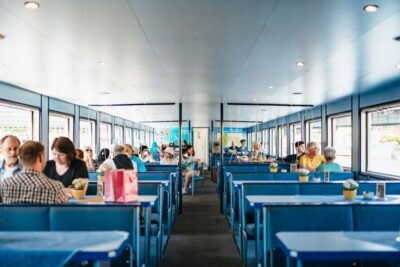
1-Hour City Tour by Boat with Guaranteed Seating
Read our review →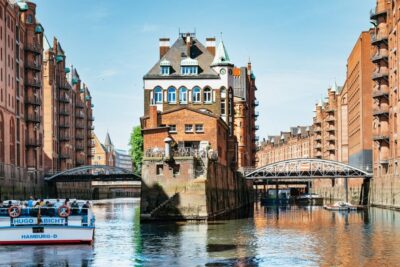
1.5-Hour Harbor and Speicherstadt Day Cruise
Read our review →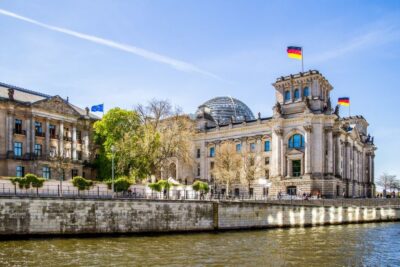
River Main Sightseeing Cruise with Commentary
Read our review →Browse the lists this tour appears in