Reviewed · BERLIN TOURS
Path of Resistance: Berlin’s Hidden Holocaust Stories
Berlin can feel like a city of monuments, but this tour makes it feel like a city of decisions. The Path of Resistance route connects major wartime sites with the people who pushed back, hid others, or simply refused to stop caring, even when it was deadly.
I like that it is small and human. You get Then & Now photos and maps so you can match what you see on the street to what stood there during the Nazi era. I also like the focus on actions, not just dates. You walk from places tied to Jewish community life to sites tied to deportations, book burnings, and resistance efforts led by people like Rudolf Christoph Freiherr von Gersdorff and Otto Weidt.
One consideration: it is a walking tour with a fair amount of standing, so comfortable shoes matter.
Key takeaways before you go
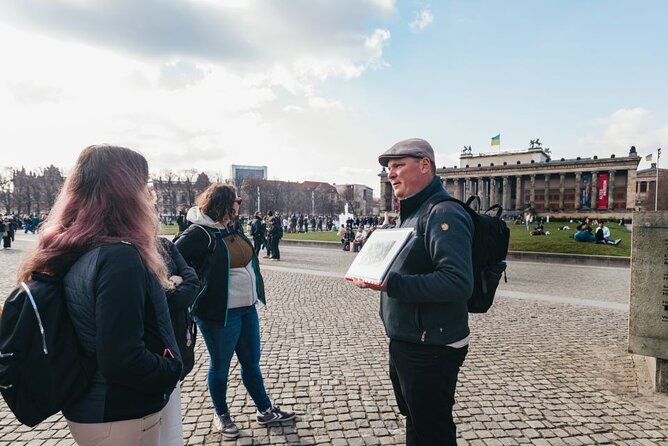
- A small-group format (max 15) keeps the pace calm and questions welcome
- Then & Now photos and maps help you “read” the streets instead of just looking at them
- Resistance stories across 10 key sites connect daily life, persecution, and survival tactics
- Free admissions are built into the stops, so your money goes to the guide, not entry fees
- Memorials and protest landmarks show how people resisted in very different ways
- Guides including Johan, Jochen, Scott, Jorg, and Benjamin are repeatedly praised for clarity and subject depth
Why This Berlin Walk Focuses on Resistance Stories
This tour works because it refuses to stay abstract. In Berlin, you can stand in front of a building and still miss what happened there. Here, you get a guided thread that ties each location to a specific act of resistance, survival, or protest under Nazi rule.
The tone is serious, but it is not just gloom. You are paying tribute to people who resisted in the only ways they could, sometimes through organizations and sometimes through individual risk. That matters because it shifts the focus from what the Nazis did to what other people managed to do anyway.
It also gives you a practical route. Two hours and 30 minutes is short enough to fit into a busy Berlin day, but long enough to move through multiple neighborhoods and key memorials without feeling rushed.
Weigh these Berlin picks against each other
- Berlin: Reichstag, Dome and Government District Guided Tour
★ 4.7 · 18,288 reviews - Berlin: 1-Hour City Tour by Boat with Guaranteed Seating
★ 4.3 · 16,993 reviews - Berlin: TV Tower Standard Entrance Ticket
★ 4.4 · 15,883 reviews
Start at the Neue Synagogue, a Place That Survived and Changed
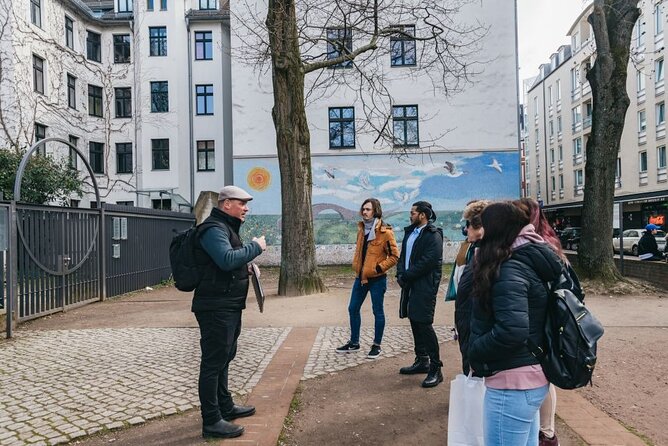
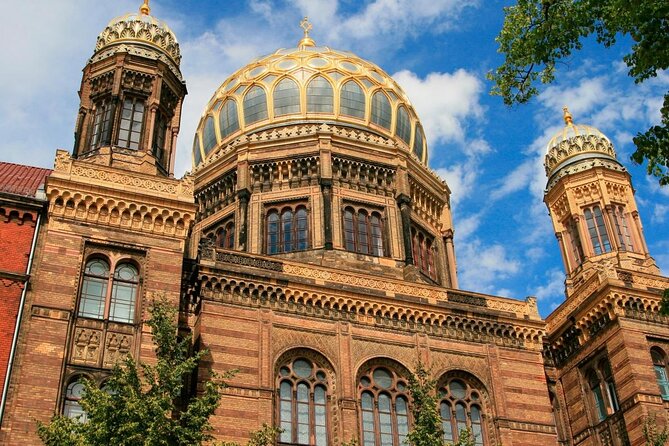
You begin at the Stiftung Neue Synagoge Berlin, also known as the Centrum Judaicum. The building matters before you even get to the war. Constructed in 1866, it was once the largest and most impressive synagogue in Berlin, representing a Jewish community estimated at 160,000 people.
Then the story turns. The synagogue survived Kristallnacht, meaning it was saved from the worst of the vandalism that hit many Jewish places. It stayed in use until 1940, when it was confiscated and repurposed for military storage, and later it suffered major damage from an Allied bombing raid in November 1943.
By 1958 the main hall was torn down, and later it was partly rebuilt in 1988 and officially reopened in 1995. Today it houses the Centrum Judaicum foundation, which helps preserve Jewish memory and tradition. That continuity, from community center to memorial institution, gives the whole walk context.
Practical tip: this is a strong start point because you are not starting with destruction only. You start with community, and then you see how persecution tried to erase it.
From a Jewish School to a Transit Camp: What the Nazis Took Away
A short walk brings you to the Jüdisches Gymnasium Moses Mendelssohn. Founded in 1779, this boy’s school was the first Jewish school in Germany with no fees. It opened to students of all faiths and promoted liberal Jewish values, and it even accepted female students in 1931.
You then learn how quickly that kind of normal, public learning got crushed. In fall 1941, deportations to newly conquered areas to the east led to banning Jewish schools. In 1942, the Reich Main Security Office under the SS turned the building into a transit camp.
What you see there now is not the transit-camp setup, but your guide helps you imagine it in a careful, non-sensational way. The windows were barred, and people were crammed inside while waiting for deportation.
Why I think this stop is essential: it shows persecution as a system that targeted institutions first. It was not random cruelty. It was policy, and it was logistical.
The Cemetery and Holocaust Memorial: Where Violence Treated Bodies as Props
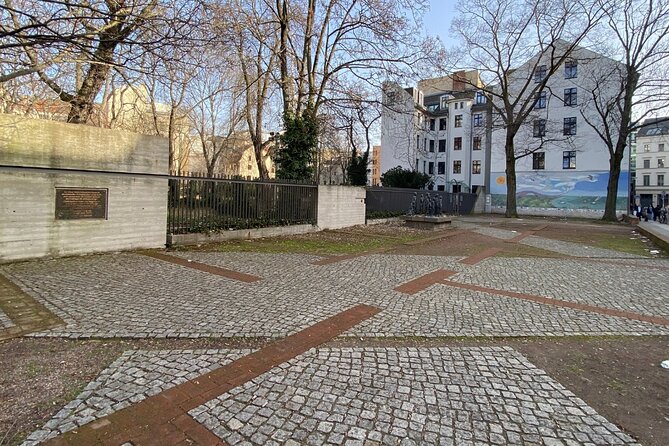
Next is the Jewish cemetery and Holocaust memorial. Between 1672 and 1827, around 12,000 Jewish community members were buried here. Then, in 1943, the Gestapo and SS destroyed the cemetery. The account here is brutally specific: gravestones were smashed, remains were thrown away, and people were reported to have played football with skulls.
That detail is hard to process, but it also explains the intent. This was not only about killing. It was about humiliating, erasing, and turning sacred sites into evidence that no one should feel safe.
In April 1945, burials took place again. About 2,500 German soldiers and Berlin civilians killed during fighting, or shot by the SS for hanging white flags from windows, were buried in mass graves.
This stop is where you feel the cost of “resistance” being framed by the regime as disloyalty. A civilian hanging a white flag could be executed, which makes the later protest stories in the tour hit harder.
Another way to spend a Berlin afternoon:
- Berlin: Boat Tour Along the River Spree
★ 4.4 · 11,252 reviews - Discover Berlin Half-Day Walking Tour
★ 5.0 · 9,624 reviews - Berlin: Government District around the Reichstag Guided Tour
★ 4.7 · 8,447 reviews - Berlin: Reichstag, Plenary Chamber, Cupola & Government Tour
★ 4.6 · 8,422 reviews
Otto Weidt’s Workshop: Small Courtyard, Big Risk
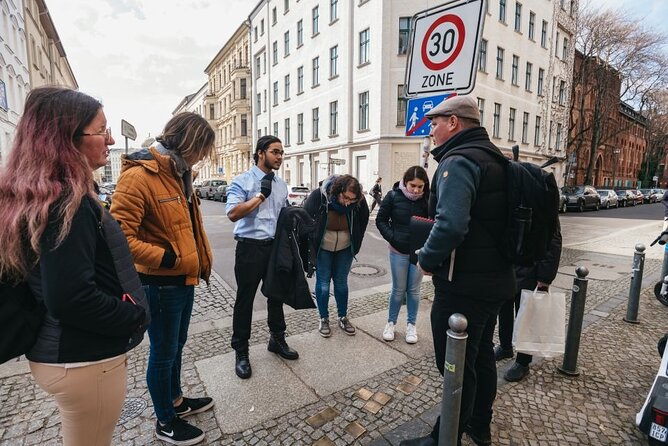
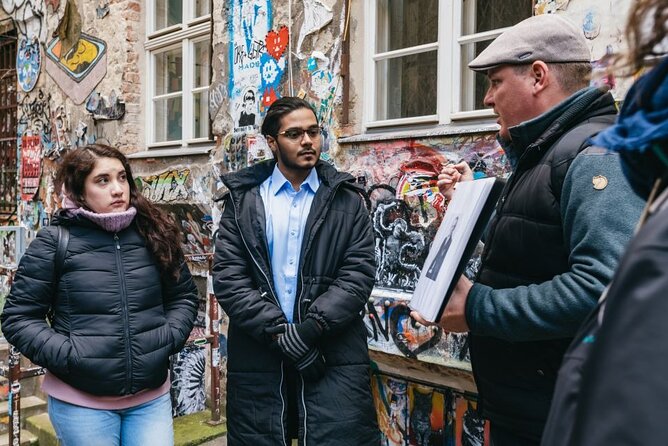
One of the most human stops is the Museum Blindenwerkstatt Otto Weidt. It sits in a hidden courtyard, which is exactly the kind of detail you want on this tour. You get a sense of what survival networks looked like, tucked in spaces you might walk past without a guide.
Otto Weidt, supported by his wife Else, employed more than 30 blind and deaf Jewish workers between 1940 and 1945. As tensions grew, Weidt tried to protect his employees from persecution and deportation.
The methods are practical and frightening: he bribed Gestapo officers, falsified documents, and kept trying even when the danger increased. The story also includes one extreme action, traveling to Auschwitz to help free one of his employees.
Why this works for you: it gives you resistance that is not only street protest. It is paperwork, relationships, and risky personal intervention. If you care about “how” people survived, this is the stop that answers it.
Rosenstraße Memorial: A Protest That Forced a Release
Then you reach Denkmal Rosenstraße, tied to one of the tour’s most powerful resistance stories. On February 27, 1943, the Gestapo, Waffen-SS, and Berlin police arrested about 2,000 Jewish men married to non-Jewish German women.
The key detail is what happened next. The wives, hundreds of them, gathered to protest. They faced threats of being shot if they did not disperse, and they did scatter briefly. But they returned in larger numbers and kept protesting as pressure mounted.
The story culminates with authorization for prisoner release, linked to Goebbels. It is a reminder that even in a climate of terror, organized public pressure could work. It was not safe, and it was not guaranteed, but it mattered.
If you only remember one idea from the tour, I hope it is this: resistance could be collective. It could be social. It could be women showing up again and again, even when they were told to stop.
Lustgarten and the Shift From Speeches to Propaganda
Now you move to the Lustgarten, framed on three sides by the Berlin Cathedral, the Altes Museum, and the Zeughaus. Before the Nazis, it was a favored location for protests and speeches, which you can still feel in the space and sightlines.
Soon after Hitler became chancellor, around 200,000 Berliners protested the new government one week later. But Nazi regulations soon made protesting dangerous, with fines and arrests used to shut down public dissent.
By 1934, the Nazis paved over the area for propaganda rallies, swearing-in ceremonies, and military parades. Your guide helps connect those shifts to what that kind of space was used for, and why that matters. A public square is never neutral under dictatorship.
A small drawback here: it can be a bit of a pause stop because the area is larger and open. Wear good shoes, and listen closely for the guidance on what to watch for around the landmarks.
Zeughaus and Gersdorff: A Plan Inside a Museum-Like Moment
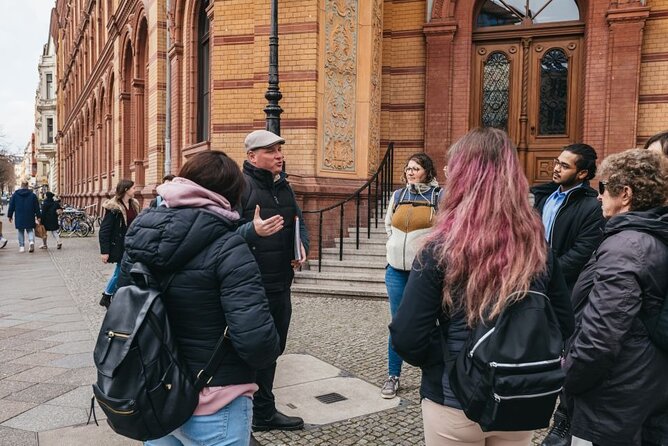
At Zeughaus, you stand in a building that was originally an artillery arsenal, constructed in 1730 along Unter den Linden. The Nazi-era use turns it into a stage.
On March 21, 1943, it was chosen to exhibit captured Soviet weapons. And in a story that feels almost surreal, Major General Rudolf Christoph Freiherr von Gersdorff, part of Wehrmacht resistance, was selected to lead the exhibit.
There had been many failed assassination attempts against Adolf Hitler. Gersdorff agreed to an assassination plan, including concealed British clam mines meant to turn a death embrace into a lethal event.
Your guide will walk you through what happened next as part of the tour. I recommend you pay attention to the sequence, because the tension is in the timing and the intention, not in dramatic ornament.
For value: this is where the tour connects “big history” to a specific, named individual with a plan, rather than leaving you with only general ideas.
Neue Wache: A Memorial in the Middle of Real Traffic
Neue Wache is different from the other stops. It is Germany’s central memorial for victims of war and tyranny, and it is located right in a busy city setting.
That contrast is the point. You are not in a quiet museum room, you are in Berlin life. The memorial asks you to hold human suffering in your mind while the city keeps moving around it.
This stop also helps you reset emotionally. After learning about destruction, deportation, and covert actions, you get a place designed for reflection.
Bebelplatz Book Burning: When Students Became Enforcers
At Bebelplatz, you visit the memorial at the site of book burnings on May 10, 1933. Nazi German Student Union members and their professors gathered here adjacent to Humboldt University. The action was framed against the un-German spirit, and students burned upwards of 25,000 volumes.
This is resistance in the opposite direction, in other words: what the regime did when it could not argue. It tried to erase ideas by destroying the physical record of them.
This stop is useful for you because it expands what “Holocaust-era resistance” can mean. The fight was not only at concentration camps. It was also at schools, universities, and the public control of knowledge.
You might not walk away with a personal action list, but you will come away understanding that violence often starts by controlling language and literature.
Trains to Life, Trains to Death: Kindertransport Hope and Deportation Reality
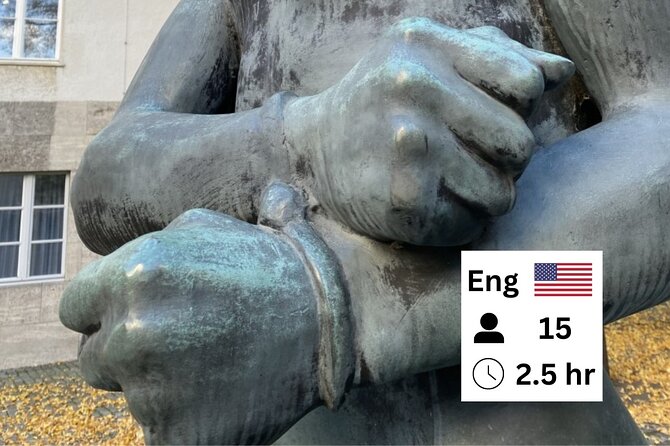
You finish with Trains to Life, Trains to Death, an almost life-size sculpture. It depicts two groups of Jewish children with contrasting fates.
One direction represents children saved through the Kindertransport to England. The other direction represents those who suffered after deportation to concentration camps. The designer, Frank Meisle, is part of the story too, because he was among those rescued by the Kindertransporte travelling from here in 1939.
This stop is a strong emotional close. It connects the tour’s theme of resistance to rescue efforts and to the devastating outcomes when rescue was not possible.
If you want a practical tip for your last minutes: stand back long enough to take in the full composition. This is not a quick photo spot. Let the contrasting directions sink in.
How the Walking Time Feels, and What the $48.01 Buys
The tour runs about 2 hours and 30 minutes, which is an efficient chunk of Berlin time. The total price is $48.01 per person, and that is where the value shows up if you care about guided interpretation.
Here is what you are paying for, beyond someone leading you from point to point:
- An expert guide who explains how each site connects to resistance and survival
- A small-group setting with a maximum of 15 travelers
- Then and Now photos and maps, which can turn a city walk into a real historical lesson
- Admission tickets listed as free at the stops, so you are not doing extra budget math mid-day
What it does not include: food and drinks. So bring a bottle of water and plan your snack before or after. Also, this is not a sit-down tour. Even though there are short stops, expect some standing.
That is also the one drawback I would underline from a planning point of view. One review note pointed out that it can be tiring because of the standing. If you have mobility limitations, it is labeled accessible, but you should still pack for comfort and pace.
Starting Point, Ending Point, and How to Fit It Into Your Berlin Day
You meet at Oranienburger Str. 36, 10117 Berlin, Germany. The walk ends at S+U Friedrichstraße, with the end noted around Friedrichstraße, Georgenstraße 14/17, 10117 Berlin, Germany. That is a major train hub, so you can easily connect to the rest of your day.
Because it is near public transportation, you do not need a complicated plan to arrive. Still, I recommend you give yourself a few extra minutes. This kind of tour benefits from arriving slightly early so you are not rushed before the first historical framing.
Also note the weather requirement. The experience requires good weather. If conditions are poor, you are offered another date or a full refund.
Who Should Book This Resistance Walking Tour
Book this if you want Berlin history tied to named people and specific choices. It is best for travelers who like walking tours with structure, and who want a guide to help them connect sites to stories you could otherwise miss.
It is also a strong fit if you value emotional clarity. The route honors those who resisted and those who lost their lives, but it keeps returning to what resistance looked like on the ground.
Families can consider it too. One write-up mentioned kids enjoying the tour, which suggests the guide style is usually clear and approachable. Still, because the topics are heavy and the walk involves standing, you know your family best.
If you are doing Berlin in a single day and you want the heavy-hitter Holocaust memorial sites, this tour can be a useful spine. If you are here for longer, it pairs well with other Jewish and WWII sites so you can build a fuller mental map.
Should You Book Path of Resistance in Berlin?
Yes, if you want a focused, small-group Berlin walk that turns memorials and landmarks into stories about resistance, survival, and protest. The strongest reason to book is the way the tour connects community life, persecution, and acts of defiance across multiple locations, with maps and Then & Now photos doing real work for your understanding.
I would pass or at least plan carefully if you dislike standing for extended periods, or if you prefer a strictly museum-based pace. This is built for walking and seeing the street-level details.
If you can do it in the morning or early afternoon, you will likely enjoy it more. You will still have the rest of the day for a calmer meal and time to process what you just learned. And since the tour is often booked in advance, locking in your date early is a smart move.
Fresh reviews out of Berlin
- Gastro Tour with Klaus though the Wrangelkiez, Kreuzberg★ 5.0 · 9 reviews
- Wall Tour Berlin – Fates, Heroes & Love Stories★ 4.0 · 9 reviews
- Berlin City Tour with Hotel pick up and Drop off★ 4.0 · 9 reviews
- Berlin Private Street Art Tour – Off The Grid★ 5.0 · 9 reviews
- Romantic Berlin Rickshaw City and Photo Tour – incl. pick-up★ 4.0 · 9 reviews
- Quatsch Comedy Club Berlin: Quatsch Comedy Hot Shot★ 4.8 · 9 reviews
- Berlin Urbex Adventure and History Tour★ 5.0 · 9 reviews
- Stag Party Berlin: Celebration for Your Bachelor Party★ 3.4 · 9 reviews
Berlin Tours, compared.
Reichstag, Dome and Government District Guided Tour
Read our review →
1-Hour City Tour by Boat with Guaranteed Seating
Read our review →
Government District around the Reichstag Guided Tour
Read our review →
Reichstag, Plenary Chamber, Cupola & Government Tour
Read our review →