
Reviewed · KOBLENZ TOURS
Koblenz – Old Town including the Deutsches Eck
This Koblenz Old Town tour is interesting because it turns a simple walking route into a clear storyline, from Münzplatz and the confluence origins to the famous memorial at Deutsches Eck. If you are new to town, you get your bearings fast, without bouncing around on your own.
I love the free-to-see sights in the mix, especially the onion-domed Liebfrauenkirche and the oldest church in Koblenz, the Basilica of St. Castor. I also like the private format for up to 15 people, so the tour feels more tailored to your group than a big crowd shuffle.
One drawback to plan for: the tour is about 2 hours, so you will be tempted to linger, especially near the end at Deutsches Eck. The route is paced for highlights, not for long inside visits or slow meandering.
Key highlights at a glance
- Münzplatz starts the story with medieval coin origins and a fountain built for Koblenz’s 2000-year anniversary
- Liebfrauenkirche onion domes plus a “romantic street” setting between two churches
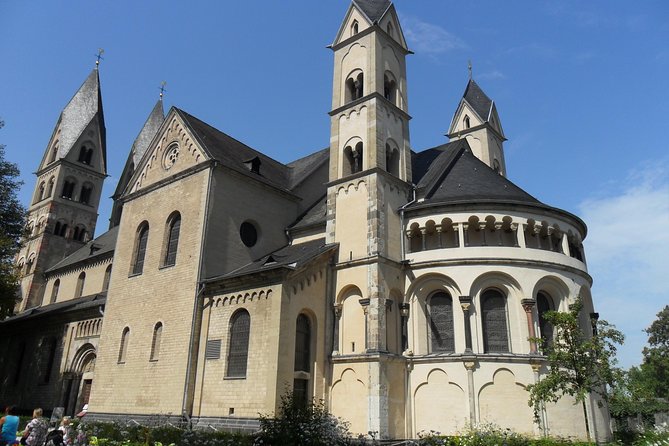
- Basilica of St. Castor dating back to the early 800s, tied to Archbishop of Trier and Emperor Louis the Pious
- Schangelbrunnen at city hall explains the name Schängel through a period of allegiance to France
- Deutsches Eck finale centers on Kaiser Wilhelm’s memorial and the headland viewpoint
- Private and English with a mobile ticket and multiple daily time options
How this Koblenz Old Town tour helps you orient fast
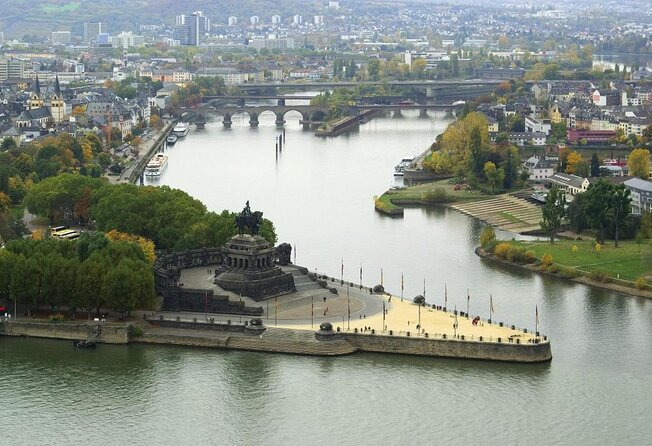
Koblenz can feel like two cities at once. You have the walkable old core with its churches and squares, and then you have the dramatic “German Corner” moment that tells you why this place matters. This tour is designed to connect those dots quickly, in a way that is easy to follow even if it is your first day in town.
The pacing is smart for a short visit. You do not try to cover everything. Instead, you hit a sequence of landmarks that each explain a different layer of Koblenz, from Roman roots to religious power to more modern national symbolism.
You will also appreciate that the stops are straightforward. Each of the main viewpoints and buildings on the route is listed with free admission for visitors, so you can focus on learning the why, not on planning ticket logistics.
Weigh these Koblenz picks against each other
- Koblenz: Rhine Valley Castles and Palaces Boat Tour
★ 4.4 · 1,824 reviews - Koblenz:Rhine Valley boat tour along the castles and palaces
★ 4.5 · 1,084 reviews - Koblenz: Old Town Sightseeing Cruise along the Rhine
★ 4.5 · 305 reviews
Starting at Münzplatz: coins, Romans, and why Koblenz has this name
Your walk begins at Münzplatz square in the old town. The name Münz links back to electoral coinage, including coins minted as far back as the 11th century. It is a small detail, but I like how the tour starts with a clue that makes the whole area feel less random.
The fountain in the square is a big part of the visual payoff. It was constructed in 1992 by Willi Heinzen as a gift from Sparkasse Koblenz, created for the city’s 2000-year anniversary. So even if you only catch a quick look, you are seeing a modern commemoration tied to an extremely old story.
Then comes the origin that makes Koblenz click. The tour connects the square to the Roman fort known as Castellum apud confluentes, a fort at the confluence. That confluence idea is part of what gives Koblenz its name, and once you hear it, the whole city layout feels more logical.
Practical note: Münzplatz is a great first stop because you get history while you are fresh. After a day of trains or arrivals, it is nice when your first “arrival moment” is also a clear orientation point.
Liebfrauenkirche and the onion domes view: church art with a reconstruction story
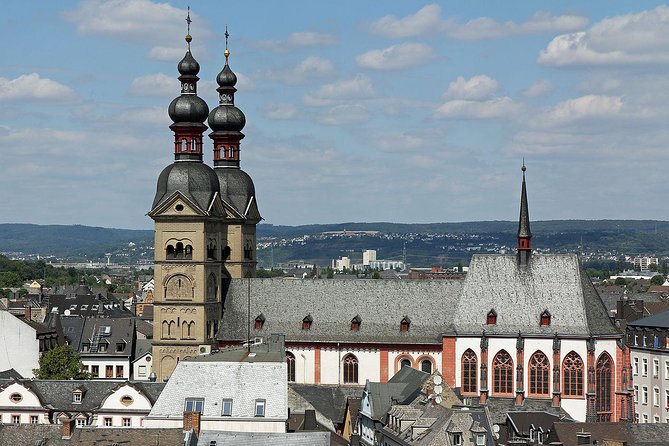
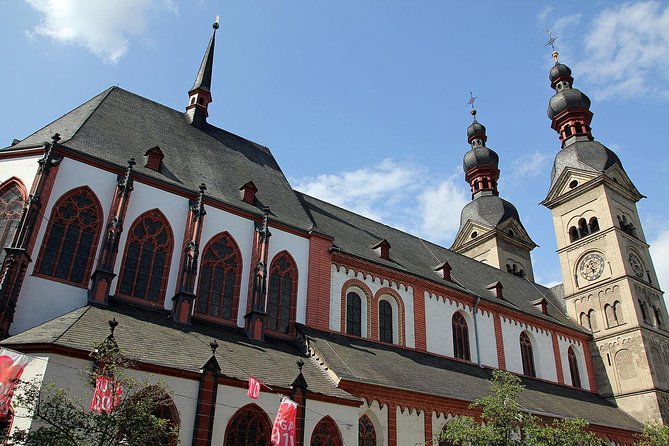
Next you head to Liebfrauenkirche, described with those instantly recognizable onion domes. The church sits on the highest point of the city, so this is not just about the architecture. It is also where you get a sense of elevation and placement in the old town.
There is a “romantic street” idea here as well, between the two churches. It is one of those settings that works for both photos and atmosphere, because you see how the buildings relate to each other in space, not just as isolated monuments.
What I find especially useful is the timeline. Liebfrauenkirche was built in the 17th century, and during the French Revolution it became one of the main parish churches. In 1944 it was destroyed, then rebuilt in 1955. That is a lot of change in a small footprint, and it helps you read the city as something that endured, adapted, and rebuilt.
Possible consideration: because the schedule gives this stop about 15 minutes, you will not have time to study every detail up close. If you like architectural features, arrive ready to focus on one or two things, like the domes and the setting, rather than trying to read everything at once.
Basilica of St. Castor: early medieval power you can actually see
The tour then moves to the Basilica of St. Castor, and it earns the “oldest church in Koblenz” label. This stop matters because it gives you a tangible anchor for the city’s deeper timeline, reaching back into the 800s.
The basilica was constructed by the Archbishop of Trier between 817 and 836, with support from Emperor Louis the Pious. That combination of church leadership and imperial backing is exactly the kind of historical connection that makes buildings more than pretty shapes.
It is built as a Carolingian proprietary church, which is a mouthful, but the effect is clear: this was not just a random local chapel. It was tied to major power structures of the time, which is why you feel the weight of it even if you are not a church-architecture specialist.
Why this works on a short tour: your other stops cover later eras and changes, like the 17th century and the post-war rebuilding. St. Castor gives you a “start point,” so the rest of the walk makes more sense.
Time tip: the stop is about 15 minutes, so if you want to spend extra time here, you will need to keep the rest of the route brisk. I usually pick one stop to go a bit slower, and this is often the one.
Another way to spend a Koblenz afternoon:
- Koblenz: Panoramic Cruise on Moselle River to Winningen
★ 4.4 · 283 reviews - Koblenz: Cable car tickets with optional admission to Ehrenbreitstein Fortress
★ 4.7 · 137 reviews - Koblenz: Rhine Valley Castle Sightseeing Cruise
★ 4.6 · 98 reviews - Koblenz: City & Sightseeing Boat tour on the Rhine
★ 4.7 · 67 reviews
Schangelbrunnen at city hall: the fountain that explains a nickname
Then you reach Schangelbrunnen, a fountain positioned by city hall that the tour presents as a symbol of Koblenz. If you have ever wondered why a place name or nickname sticks, this stop is your answer.
The word Schängel comes from Koblenz’s 20-year allegiance to France from 1794 to 1813. That means the fountain is doing a job that is bigger than decoration. It ties the city’s identity to a specific period of political history, with a nickname that people still recognize.
The fountain was designed by Carl Burger in 1940 and dedicated to the famous poet Josef Cornelius. Even if you only glance at it, you get a layered message: political history, plus culture, plus a specific creator and dedication.
Possible drawback: fountains are great for quick photo stops, but the short time here means you might not get a slow, reflective look. If you like spending time with water features and sculpture, this is where you might wish you had five extra minutes.
Still, this stop is valuable because it adds local color, and it helps you understand the city’s identity in everyday terms, not just museum-style facts.
Deutsches Eck finale: Kaiser Wilhelm’s memorial and the headland moment
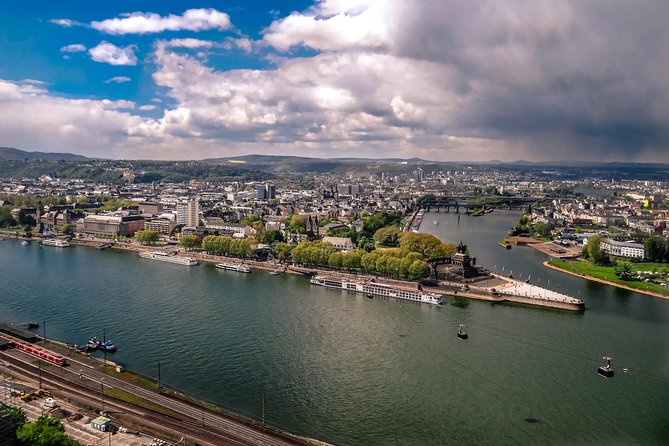
The tour’s final chapter is Deutsches Eck, also called the German Corner. It refers to the headland in Koblenz, and it is where national symbolism takes center stage.
You will see the Kaiser Wilhelm memorial. The tour notes that Kaiser Wilhelm was the first German Emperor, and that the memorial was erected in 1897. This is a very different kind of history than your earlier stops. Instead of older church foundations and reconstruction stories, you are looking at how a nation chose to commemorate leadership.
This ending also gives you the best “walk away with a view” opportunity. The schedule gives this stop about 35 minutes, which is longer than the others, because the headland setting rewards time. It is the moment where you can step back, look outward, and connect the city’s confluence origins to what you can actually see from the edge.
Practical consideration: if you are the type who likes to linger, plan to use that extra time wisely. Bring your camera, but also bring your eyes for the big composition. You will remember Deutsches Eck more by the overall view than by any single detail.
What 2 hours feels like on the ground
This is a short tour, about 2 hours, with a clear sequence: Münzplatz, Liebfrauenkirche, St. Castor, Schangelbrunnen, then Deutsches Eck. The time allocations are roughly 15 minutes for the first four stops and about 35 minutes for the finale, which means you get real variety without feeling trapped in one location.
For many people, this is the ideal format on a first day. You walk enough to learn the city, but not so much that you are exhausted before dinner. And because it is private, your group can keep the pace comfortable.
One more practical advantage: you get a mobile ticket. That tends to make the experience feel smoother, especially if you are juggling trains, parking, or just walking straight from your hotel.
Also, it is offered in English. If you prefer guides to put history into plain words, this is a good match.
Price and value: what $420.53 per group really means
The price is $420.53 per group, up to 15 people. That changes the math. If you are traveling as a small group, it can be a good value because you get a private introduction rather than paying for individual tickets that add up quickly.
For solo travelers or couples, it might feel like a lot at first glance, but the private factor matters. You are not competing with a large crowd, and you are more likely to get answers to your specific questions about what you are seeing.
Here is the value angle that I think you should focus on: this tour helps you avoid the most common first-time mistake in historic cities, which is wandering without a story. When you know the “why” behind a square, a church, or a memorial, your time in Koblenz becomes more satisfying, even on days when you only have a short window.
Bonus evidence point: the experience carries a 4.7 overall rating with 16 evaluations and 94% recommending it. I treat that as a useful signal, not a guarantee, but it lines up with the format you are getting.
Who this private Koblenz tour suits best
This is a strong fit if you are:
- In Koblenz for the first time and want a guided route that makes sense
- Traveling with a group of up to 15 people who want the comfort of a private experience
- Prefer a short, focused introduction over a long day of sightseeing
It is also well suited for people who like history, but do not want to spend a whole afternoon reading plaques. The stops are chosen so each one contributes a piece of the bigger picture: medieval coin origins, church history and rebuilding, Carolingian-era beginnings, and a national memorial ending.
If you are the type who loves slow, deep inside visits, you can still do this. Just know what to expect. You will see the key landmarks, but you will be on a highlight schedule.
Practical tips before you go (so the walk feels easy)
Start by showing up at Münzplatz with comfortable walking shoes. The stops are spread in a way that is easy to follow, but you will still be on your feet for the full route.
Next, have your plan for photos. You will get the best photo stretch at the end near Deutsches Eck, since the finale has the most time. At the earlier stops, pick one or two visual elements to focus on, like the onion domes at Liebfrauenkirche or the symbolism tied to Schängelbrunnen.
Since it is near public transportation, you do not need to overthink logistics if you are arriving by bus or train. Just keep your meeting address handy: Münzplatz in the old town area, and the tour ends at Konrad-Adenauer-Ufer by Deutsches Eck.
Finally, remember it is about 2 hours. If you have a tight connection later, you will still likely manage it because the route ends after the headland finale and the main highlights are concentrated along the way.
Should you book this Koblenz Old Town and Deutsches Eck tour?
If you want an efficient first pass through Koblenz, I recommend booking. This is the kind of introduction that pays off immediately, because each stop explains what you are looking at, from Roman confluence origins to the oldest church in Koblenz, then through church rebuilding and local identity, ending at the Kaiser Wilhelm memorial at Deutsches Eck.
Skip it only if your priority is long, in-depth visits inside buildings. The time at each stop is limited on purpose, so you will get the highlights, not a slow museum-style experience.
If you are traveling in a group of up to 15, the private format makes the most sense. You get a guided storyline without turning your day into a self-guided puzzle.
FAQ
How long is the Koblenz Old Town and Deutsches Eck tour?
It lasts about 2 hours.
What is the meeting point and where does the tour end?
The tour starts at Münzplatz (Münzpl., 56068 Koblenz, Germany) and ends at Deutsches Eck (Konrad-Adenauer-Ufer, 56068 Koblenz, Germany).
How much does the tour cost?
It costs $420.53 per group, up to 15 people.
Is this tour private?
Yes. It is a private tour, and only your group participates.
What language is the tour offered in?
The tour is offered in English.
Do I need to buy tickets for the stops?
The stops listed are free to enter, with free admission ticket noted for each stop.
What do I use for the tickets?
You get a mobile ticket.
When should I book?
Confirmation is received at time of booking, and it is commonly booked about 27 days in advance.
Is the meeting area easy to reach by public transportation?
The meeting point is near public transportation.
What is the cancellation policy?
You can cancel for a full refund up to 24 hours in advance of the experience start time. Free cancellation is available up to that point.
Fresh reviews out of Koblenz
- Koblenz: The Living Vineyard, Nature & Wine Enjoyment★ 5.0 · 14 reviews
- e-Scavenger hunt Koblenz: Explore the city at your own pace★ 4.0 · 20 reviews
- Discovery tour – cellar tour with wine tasting★ 4.2 · 26 reviews
- Winetasting / Weinprobe Koblenz★ 4.3 · 31 reviews
- Koblenz: Christmas Boat Tour with Mulled Wine★ 4.3 · 35 reviews
- Koblenz: Sektmuseum Histor. Kelllergewölbe incl. 1 Glas Sekt★ 4.5 · 41 reviews
- Koblenz: City & Sightseeing Boat tour on the Rhine★ 4.7 · 67 reviews
- Koblenz: Rhine Valley Castle Sightseeing Cruise★ 4.6 · 98 reviews
Koblenz Tours, compared.
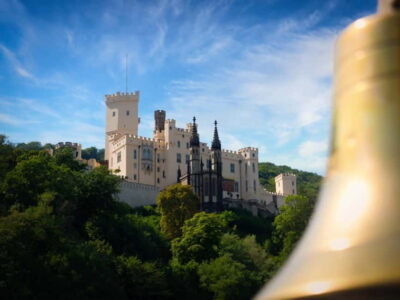
Rhine Valley boat tour along the castles and palaces
Read our review →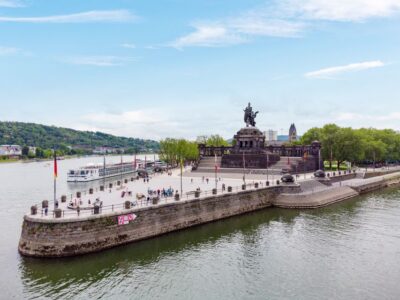

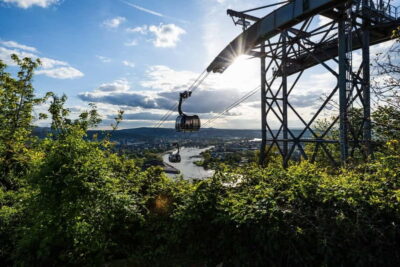
Cable car tickets with optional admission to Ehrenbreitstein Fortress
Read our review →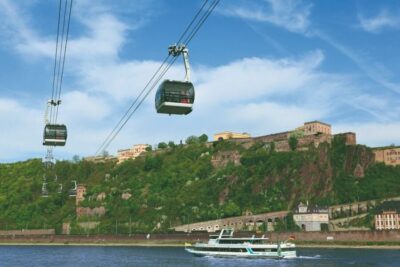
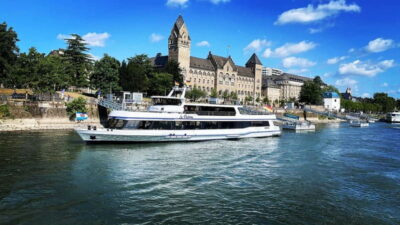
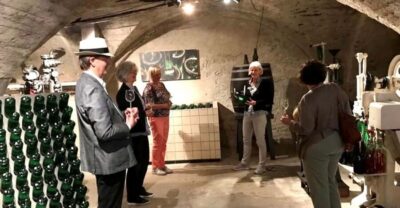
Sektmuseum Histor. Kelllergewölbe incl. 1 Glas Sekt
Read our review →Browse the lists this tour appears in